


Behind every piece of media coverage, there is writing.
A pitch that made a journalist stop scrolling. A press release that gave an editor exactly what they needed. A brand bio that communicated credibility in three sentences. A contributed article that positioned a founder as the definitive voice on a topic their audience cares about.
None of that happens by accident. It happens because someone understood that PR writing is not just communication – it is strategy expressed through language.
Most businesses underinvest in PR writing. They treat it as an afterthought, a task to check off rather than a craft to develop. They send generic press releases to anyone with a media email address. They write brand bios that read like job descriptions. They pitch journalists with paragraphs that bury the point.
And then they wonder why they are not getting coverage.
This guide breaks down what PR writing actually is, why it is one of the most important skills in any media strategy, and how to use it effectively to build brand identity, earn coverage, and shape the narrative around your brand.
What PR Writing Is – and What It Is Not
PR writing is the craft of creating written content that shapes public perception, builds credibility, and supports a brand’s media and communications strategy.
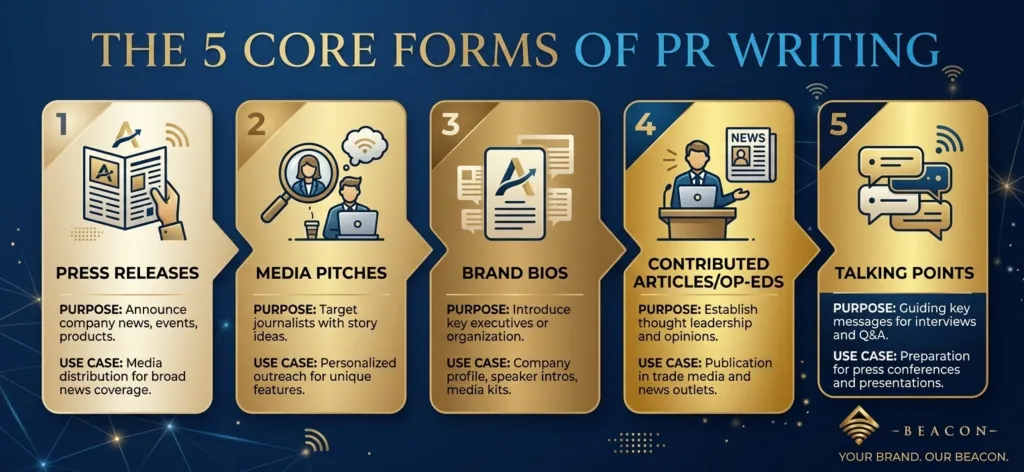
It includes press releases, media pitches, brand bios, media kits, contributed articles, op-eds, talking points, crisis communications, award submissions, speaking proposals, and executive thought leadership content.
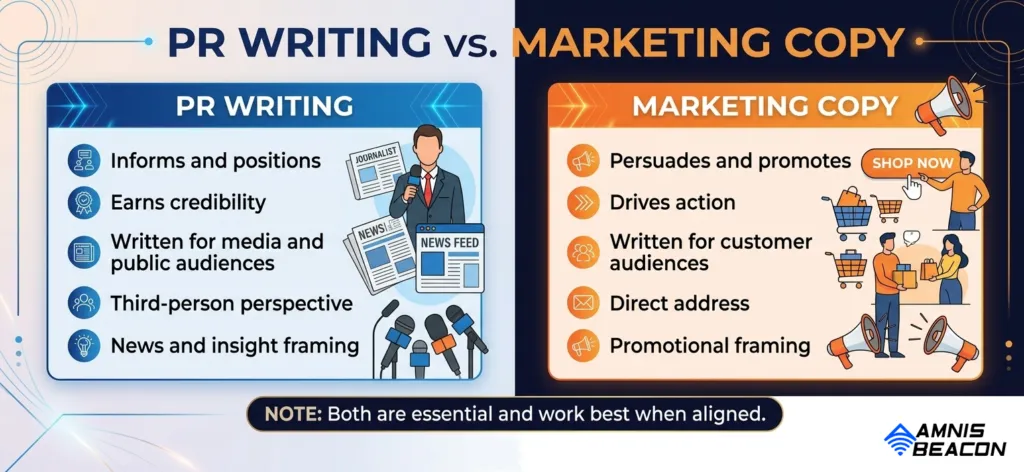
What PR writing is not is marketing copy. The distinction matters.
Marketing copy is written to persuade your audience to take a specific action – click, buy, sign up. It is promotional by nature, and the audience knows it.
PR writing is written to inform, position, and earn – to give journalists, editors, podcast hosts, event organizers, and the public the information they need to form a specific perception of your brand. It is not overtly promotional. The most effective PR writing does not read like advertising at all. It reads like news, like insight, like authoritative perspective.
That difference in intent changes everything – the tone, the structure, the vocabulary, the angle, and the outcome.
Why PR Writing Is Central to Any Media Strategy
A media strategy without strong PR writing is a strategy without execution.
You can identify the right journalists. You can build the right media list. You can know exactly which publications your target audience reads and exactly which podcasts they listen to. But if the writing you put in front of those journalists and hosts is weak, generic, or misaligned – none of that targeting matters. The pitch gets deleted. The press release gets ignored. The opportunity disappears.
PR writing is the mechanism through which your media strategy actually connects with the media. It is the point of contact between your brand and the journalists, editors, and hosts who have the ability to put your story in front of audiences you could never reach on your own.
And it does more than open doors. Strong PR writing shapes the coverage that results from those opened doors. A well-written press release gives a journalist the framing, the facts, and the quotes they need to cover your story accurately – the way you want it covered. A precisely crafted media pitch positions your brand within a narrative that aligns with your identity and your strategic goals. A polished brand bio ensures that every time someone writes about you, they start from an accurate, credible description of who you are.
PR writing is not just the way you ask for coverage. It is the way you shape what that coverage says.
The Core Forms of PR Writing and Why Each One Matters
Press Releases
The press release is the most traditional form of PR writing – and one of the most misunderstood.
A press release is not a company announcement. It is a news story, written in journalistic style, that gives a journalist everything they need to cover a story about your brand quickly and accurately.
The most common mistake in press release writing is treating it like a marketing document. Long introductions about how excited the company is. Paragraph after paragraph of promotional language. Quotes that sound like taglines rather than statements a real person would make.
Strong press releases are written like news. They lead with the most important information – who, what, when, where, and why it matters – in the first sentence. They use inverted pyramid structure, with the most critical information at the top and the supporting context below. They include a genuine, quotable statement from a relevant spokesperson. And they close with a concise boilerplate that describes the company clearly and accurately.
A well-written press release does not just announce something. It tells a journalist exactly what the story is and why their readers should care about it.
Media Pitches
A media pitch is a short, targeted message – usually an email – that introduces a story idea to a specific journalist or editor and invites them to cover it.
Pitches are arguably the most important form of PR writing in a modern media strategy. In a world where journalists receive hundreds of pitches a week, the quality of your writing determines whether yours gets read or deleted in the first three seconds.
Strong pitches have a few things in common. They are short – typically under 200 words. They lead with the most compelling element of the story, not with background on the company. They are clearly tailored to the specific journalist’s beat and audience. They make the story angle obvious and the relevance undeniable. And they make it easy to say yes – with a clear ask and all the relevant information a journalist needs to move forward.
The subject line is its own discipline. A pitch with a weak subject line never gets opened, regardless of how strong the body is. Subject lines that work are specific, intriguing, and immediately relevant to what the journalist covers.
Brand Bios
A brand bio – or executive bio – is a short written summary of who a brand or individual is, what they do, and why they are credible.
It appears in media kits, on speaker profiles, in podcast episode descriptions, in conference programs, and at the top of contributed articles. It is often the first thing a journalist or editor reads about you – and frequently the source from which their introductory description of your brand is drawn.
Most brand bios are written too generically. They list credentials and titles without communicating a clear positioning. They describe what someone does without explaining why it matters. They are accurate but unmemorable.
Strong brand bios are written with the same intentionality as any other brand communication. They reflect the brand’s positioning and personality. They communicate credibility specifically – through results, clients, expertise, and perspective – not just through titles and years of experience. They give the reader an immediate, clear sense of who this brand is and why they are worth paying attention to.
Every brand should have a bio in three lengths – a one-sentence version, a short paragraph version (three to four sentences), and a full version (one to two paragraphs). Each serves a different context and each should be written to the highest standard.
Contributed Articles and Op-Eds
Contributed articles and op-eds are one of the most powerful and most underused forms of PR writing available.
A contributed article is a piece of editorial content – written by a brand representative or executive – that is published in a media outlet as expert commentary or insight. An op-ed is an opinion piece that presents a specific, argued point of view on a topic of public relevance.
Unlike a press release or a pitch, a contributed article gives a brand the space to demonstrate expertise in depth. It is not a pitch for coverage – it is the coverage itself. And because it is published under the brand’s byline in a credible editorial outlet, it carries significant authority.
The key to effective contributed article writing is that it must genuinely serve the publication’s audience. It cannot be promotional. It cannot be thin or generic. It needs to deliver real insight, a specific perspective, or actionable information that the outlet’s readers will find valuable.
When contributed articles are done well, they are among the highest-value PR assets a brand can produce. They earn credibility, generate backlinks, demonstrate thought leadership to a new audience, and become shareable content that continues working long after the publication date.
Talking Points and Message Guides
Talking points are the structured, pre-written summaries of the key messages a brand spokesperson should communicate in interviews, panel discussions, media appearances, and public events.
They are not scripts. They are frameworks – the core ideas, supporting evidence, and memorable phrases that keep a spokesperson on-brand and on-message regardless of where the conversation goes.
Talking points are an often overlooked form of PR writing, but they are critically important for brand consistency. Without them, every spokesperson makes their own decisions about what to emphasize – and the cumulative impression across multiple appearances becomes inconsistent.
Strong talking points are brief, memorable, and written in natural spoken language. They anticipate the most common questions and difficult angles. And they are updated regularly to stay current with the brand’s positioning and the evolving media landscape.
The Relationship Between PR Writing and Brand Voice
One of the most important – and most frequently neglected – connections in brand communication is between PR writing and brand voice.
Brand voice is the consistent character and personality your brand expresses through all written communication. It is what makes your emails, social media posts, website copy, and marketing materials feel like they come from the same source.
PR writing should be an extension of that voice – adapted for the context (more formal in a press release, more conversational in a pitch) but always recognizably from the same brand.
When PR writing is disconnected from brand voice, the result is a fractured brand experience. A journalist reads a pitch that feels warm and confident, then visits the website and encounters copy that feels corporate and distant. A podcast listener hears a founder speak with genuine personality, then reads a press release that sounds like it was written by a committee. Those disconnects are subtle but cumulative – they create a sense of inconsistency that erodes the trust PR is trying to build.
Aligning PR writing with brand voice requires two things. First, a clearly defined brand voice – documented, specific, and shared with everyone who writes on behalf of the brand. Second, the discipline to apply that voice consistently across every PR writing format, even the ones that traditionally feel more formal or formulaic.
The brands that do this well create a communication experience that is coherent from the first pitch to the published article to the interview to the website visit. Every touchpoint reinforces the same impression. And that consistency is what turns individual pieces of coverage into a cumulative brand identity that sticks.

PR Writing in the Age of Digital Media
The principles of strong PR writing have not changed. But the context in which that writing operates has changed significantly – and understanding those changes is essential for any brand building a media strategy in 2026.
The pitch window is shorter. Journalists are busier, inboxes are fuller, and attention is more fragmented than ever. The writing that earns a response in 2026 is tighter, more specific, and more immediately relevant than what worked five years ago. Every word has to earn its place.
SEO is now a PR writing consideration. Digital coverage generates backlinks. Press releases published online are indexed by search engines. Contributed articles drive referral traffic for months or years after publication. The principles of SEO – keyword relevance, clear structure, descriptive headings, and specific anchor text – are now relevant to PR writing in ways they were not in the era of print media.
Multimedia context matters. Digital journalists and editors often want supporting assets alongside written pitches – data visualizations, video clips, high-resolution images, infographic summaries. Strong PR writing in 2026 is not just the text – it is the written content working alongside visual and multimedia assets to tell a complete, compelling story.
The audience has expanded. In traditional PR, the primary audience for PR writing was the journalist or editor. In modern PR, that writing is often published verbatim (press releases on newswires), shared directly on owned social channels, or read by potential customers who encounter media coverage and click through to the source. PR writing now needs to work for multiple audiences simultaneously.
AI is changing the baseline. As AI writing tools become more widely used, the baseline quality of PR writing has risen – and simultaneously become more generic. The brands that stand out in 2026 are the ones producing PR writing with a genuine point of view, specific details, and a recognizable brand voice. Generic is no longer good enough. Specific, substantive, and human is the new standard.
How to Improve Your Brand’s PR Writing
You do not need a dedicated PR writer to produce strong PR writing. You need the right framework, a clear brand voice, and consistent practice.
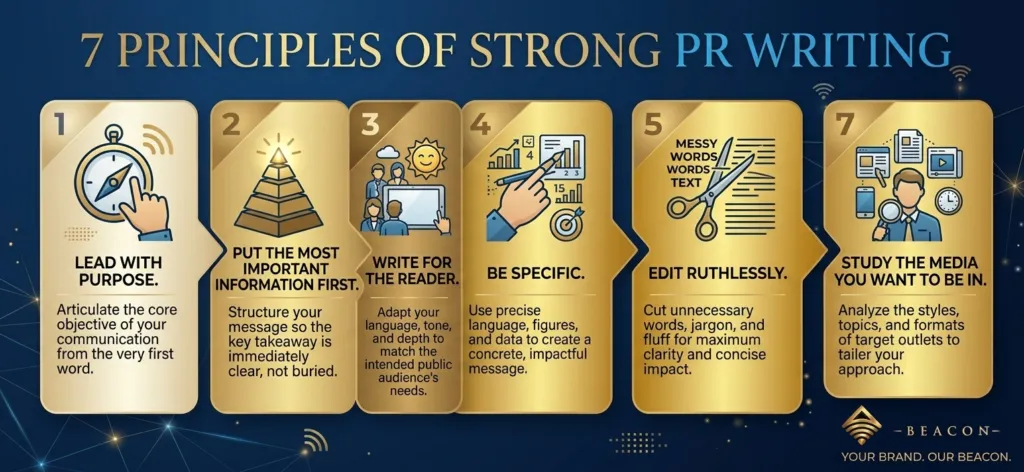
Start with clarity of purpose. Before writing any PR document, be clear on what you are trying to achieve. What story are you telling? Who is the audience? What do you want them to think, feel, or do after reading this? Every PR writing decision should follow from those answers.
Lead with the most important information. Whether you are writing a press release, a pitch, or a bio – the most compelling information goes first. Journalists do not have time to excavate your key point from the third paragraph. Put it in the first sentence.
Write for the reader, not for the brand. The most common PR writing mistake is writing from the brand’s perspective rather than the reader’s. A journalist’s reader is not interested in how excited your company is about a new product. They are interested in why that product matters to them. Make that case first.
Be specific. Vague language is the enemy of credible PR writing. Numbers, names, results, and concrete details are more persuasive than adjectives. “We increased our clients’ brand recognition by 40 percent in six months” is more compelling than “we deliver exceptional results.”
Edit ruthlessly. Strong PR writing is tight. Every sentence should earn its place. If a paragraph does not advance the story or add essential context, cut it. Shorter is almost always stronger in PR writing – especially in pitches and press releases.
Align every piece with your brand voice. Before sending or publishing any PR writing, check it against your brand voice guidelines. Does it sound like your brand? Does it reinforce the positioning and personality you have defined? If not, revise before it goes out.
Study what earns coverage. Read the publications you want to be in. Pay attention to what the covered stories have in common – the angles, the structure, the framing. The best PR writers are avid readers of the media they are trying to place in.
Final Thoughts
PR writing is not a commodity skill. It is a strategic asset – one that determines whether your media strategy produces real results or real frustration.
The brands that earn consistent, high-quality coverage are not always the ones with the biggest news or the most interesting stories. They are often the ones with the clearest writing, the most targeted pitches, and the most consistent brand voice across every piece of communication they send.
In a media landscape that is more competitive, more fragmented, and more skeptical of promotional messaging than ever, the quality of your PR writing is a genuine competitive advantage. It is the difference between a brand that shapes its narrative and one that is shaped by it.
Invest in the craft. Build the systems. Align the writing with the identity. And use every word as an opportunity to earn the trust and credibility your brand deserves.
If you are ready to build a brand identity and communication strategy strong enough to earn the coverage and credibility your business deserves, explore Amnis Beacon’s brand strategy services or get in touch to start a consultation.
Amnis Beacon specializes in brand identity and brand strategy consulting for businesses, public figures, and influencers. We combine analytics, psychology, and market intelligence to build brands that are credible, consistent, and built to grow.