

Some brands become part of culture. Others quietly disappear.
The difference is rarely the product. It is rarely the budget. More often, it comes down to one thing: how intentionally the brand was built.
Branding is one of the most powerful forces in business – and one of the most misunderstood. Most people think branding is about logos and colors. Those things matter, but they are not the whole picture.
Branding is about perception. It is about the story people tell themselves when they encounter your business. It is about the feeling that stays with someone long after the transaction ends.
This guide breaks down what branding actually means, what separates powerful brands from forgettable ones, and what lessons you can pull from the world’s most recognized brands – regardless of your size or stage.
What Branding Actually Means
Branding is the process of shaping how your business is perceived – deliberately and consistently over time.
It is not a single design decision. It is not a logo refresh. It is the sum of every interaction, visual, message, and experience your audience has with your business.
Jeff Bezos said it well: “Your brand is what people say about you when you are not in the room.”
That means branding is not just about what you put out. It is about what sticks. What gets remembered. What gets repeated.
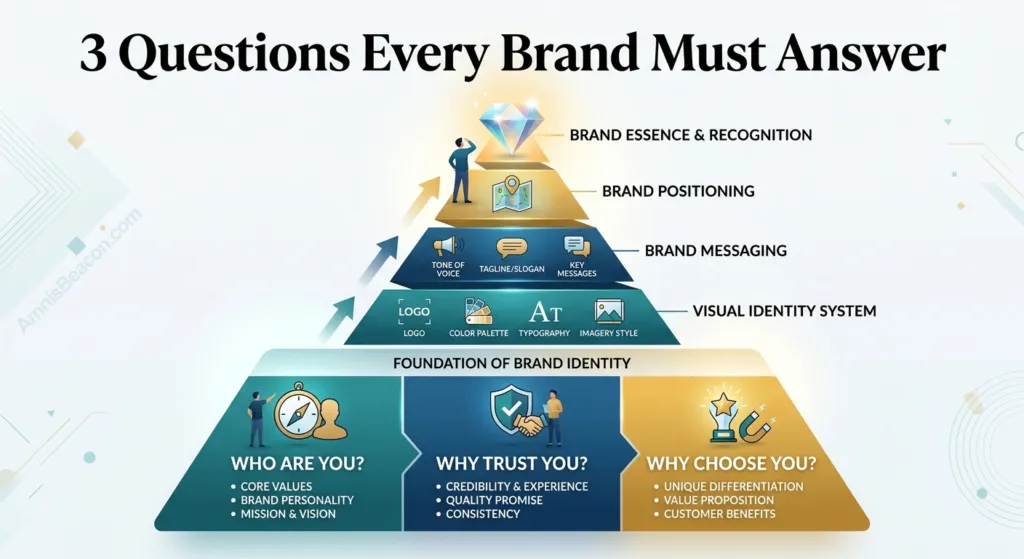
Effective branding answers three questions for your audience:
- Who are you?
- Why should I trust you?
- Why should I choose you over everyone else?
When your brand answers those questions clearly and consistently, it stops being a cost center and starts being a competitive advantage.
The Anatomy of a Powerful Brand
Powerful brands are not built on aesthetics alone. They are built on a combination of strategic clarity and consistent execution across every layer of the business.
Here is what that looks like in practice.
Brand Purpose
Purpose is the reason your brand exists beyond making money. It is the deeper “why” behind what you do.
Purpose-driven brands do not just attract customers – they attract believers. People who share the same values. People who become advocates without being asked.
Your purpose does not have to be world-changing. It just has to be genuine and clearly communicated.
Brand Positioning
Positioning defines where your brand sits in the market – and in the minds of your audience.
It answers the question: compared to every other option available, why is this the right choice for this specific person?
Strong positioning is specific. Vague positioning – “we provide quality service” or “we are passionate about what we do” – says nothing. It does not differentiate you. It blends you into the noise.
Brand Personality
Brands with personality are memorable. They feel human. They attract a specific type of person and repel others – and that is intentional.
Your brand personality shows up in how you write, how you design, how you respond to customers, and what you choose to talk about. It is the character behind the brand.
Brand Promise
Your brand promise is the consistent expectation you set for your audience. It is the thing you deliver on, every time, without exception.
Trust is built when promises are kept. Brand equity is lost when they are not.
Visual Identity
Your visual identity – logo, colors, typography, imagery – is the language your brand speaks without words. It triggers recognition, communicates credibility, and sets the tone before a single sentence is read.
Visual identity without strategic foundation is decoration. With it, it becomes a powerful signal.

Lessons from Leading Brands
The world’s most powerful brands did not get there by accident. Each made deliberate decisions about how they wanted to be perceived, who they wanted to attract, and what they stood for. Here is what you can learn from them.
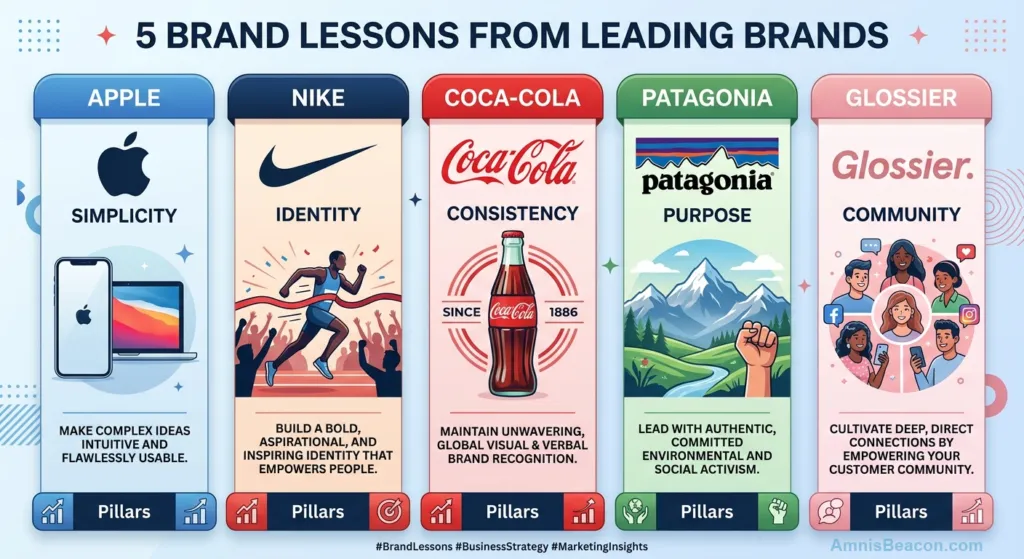
Apple – Simplicity as a Strategy
Apple built one of the most valuable brands in history on a single principle: simplicity.
Their products are simple. Their design is simple. Their messaging is simple. “Think Different.” “1,000 songs in your pocket.” These are not complicated ideas – they are clear, human, and memorable.
The lesson: Clarity beats complexity every time. If your audience has to work to understand you, you have already lost them.
Apple also understood the power of consistent visual identity. Every product, every store, every advertisement speaks the same visual language. That consistency built recognition at a global scale.
Nike – Identity Over Product
Nike does not sell shoes in their advertising. They sell identity.
“Just Do It” is not a product claim. It is a belief system. Nike’s branding has always been about the athlete inside every person – the discipline, the grit, the refusal to quit. The shoes are almost secondary.
The lesson: The most powerful brands sell a version of who your customer wants to become. They create belonging. They give people something to identify with beyond the transaction.
Nike also mastered the emotional dimension of branding. Their campaigns consistently make people feel something – and emotion is one of the most powerful drivers of brand loyalty.
Coca-Cola – The Power of Consistency
Coca-Cola has been building its brand for over 130 years. Their logo has barely changed. Their red color is instantly recognizable worldwide. Their association with happiness, togetherness, and celebration has been reinforced across generations.
The lesson: Consistency compounded over time creates brand equity that competitors cannot easily replicate. Every time you are tempted to change something that is already working, ask yourself what Coca-Cola would do.
Patagonia – Purpose as Positioning
Patagonia built their entire brand around a clear purpose: protecting the environment. Not as a marketing campaign – as a core business value embedded in every decision they make.
They donate 1 percent of sales to environmental causes. They tell customers to repair gear instead of replacing it. They even ran an ad that said “Don’t Buy This Jacket.”
The result is a loyal, passionate customer base that trusts the brand completely because the brand has proven its values consistently.
The lesson: When your purpose is real and your actions back it up, branding becomes effortless. Your customers do the marketing for you.
Glossier – Community as Brand Strategy
Glossier built a beauty brand by treating their customers as collaborators. They listened to what their audience wanted, involved them in product decisions, and built a brand that felt like it belonged to the community – not just the company.
The lesson: In today’s market, the most powerful brands are built with their audience, not just for them. Engagement, conversation, and co-creation build a level of loyalty that advertising alone cannot buy.
The Psychology Behind Powerful Brands
Branding works because people make decisions based on emotion and justify them with logic.
When someone chooses your brand, they are rarely making a purely rational calculation. They are responding to how your brand makes them feel – safe, inspired, understood, elevated, or aligned with their own values.
This is why brand psychology matters.
Color psychology shapes perception before a single word is read. Blue communicates trust and stability (used heavily in finance and tech). Red communicates energy and urgency. Green communicates health and sustainability. Your color choices should be deliberate, not default.
Social proof is one of the most powerful forces in branding. Testimonials, case studies, partnerships, and media mentions all serve as signals that others have trusted you – and that it paid off.
Anchoring shapes how people perceive your value. The context your brand creates around itself directly influences what customers believe you are worth. A premium visual identity commands premium pricing – not because the service changed, but because the perception did.
Familiarity builds trust. The mere exposure effect shows that people develop a preference for things they have seen repeatedly. Consistent branding leverages this. Every repeated exposure builds familiarity. Familiarity builds trust. Trust drives decisions.
The Biggest Branding Mistakes Businesses Make
Understanding what not to do is just as valuable as knowing what to do.
Inconsistency across touchpoints. Your website, social media, proposals, and emails should all feel like they come from the same brand. When they do not, customers sense the disconnect – even if they cannot name it.
Building a brand that appeals to everyone. A brand that speaks to everyone speaks to no one. Specificity is a strength. Know exactly who you are for – and make that clear.
Prioritizing trends over timelessness. Following every design trend is a fast track to a brand that feels dated in two years. Strong brands are built for longevity, not novelty.
Confusing activity with brand building. Posting constantly on social media is not branding. Creating content without a clear strategy, voice, or identity behind it does not build a brand – it just adds noise.
Skipping the strategy. Many businesses jump straight to design without doing the foundational strategic work first. The result is a brand that looks fine but does not connect, convert, or build loyalty.

How to Apply These Lessons to Your Own Brand
You do not need Apple’s budget or Nike’s history to apply these principles. The frameworks are the same at every scale.
Start with clarity. Before any design decisions, get clear on your purpose, your audience, your positioning, and your brand personality. These are not marketing exercises – they are business decisions that everything else should be built on.
Build for consistency. Every touchpoint your audience encounters should feel like it belongs to the same brand. Invest in brand guidelines and use them.
Think long-term. Brand equity is built over time. Resist the urge to constantly reinvent or chase trends. Make decisions you can commit to for years.
Connect emotionally. What does your brand make people feel? What identity does it give them permission to step into? The brands that last are the ones that create genuine emotional connection.
Let your values show. You do not need a cause as clear-cut as Patagonia’s to stand for something. But your values should be visible in how you operate, communicate, and deliver. Authenticity is not a marketing strategy – it is the baseline for trust.
Treat your audience as partners. The best brands today are built in conversation with their community. Listen, respond, involve, and adapt. Your audience will tell you what they need if you are paying attention.
Final Thoughts
The brands that stand the test of time are not the ones with the biggest budgets. They are the ones with the clearest sense of who they are, the most consistent execution across every touchpoint, and the deepest understanding of the people they serve.
Branding is not a one-time project. It is an ongoing commitment to showing up the same way, delivering on your promises, and evolving with intention.
Whether you are building from scratch or refining what you already have, the principles are the same. Clarity. Consistency. Connection.
That is the art of branding – and it is available to every business willing to do the work.
If you are ready to build a brand that reflects the quality of your work and stands out in your market, explore Amnis Beacon’s brand strategy and identity services or download the free strategic branding guide.
Amnis Beacon specializes in brand identity and brand strategy consulting for businesses, public figures, and influencers. We combine analytics, psychology, and market intelligence to build brands that are credible, consistent, and built to grow.