


Most business owners know they need a brand. Far fewer understand what a brand identity actually is – or why getting it right changes everything.
If you have ever felt like your business is not connecting the way it should, that your marketing is not landing, or that your visuals do not reflect the quality of your work, there is a good chance the root issue is brand identity.
Not the logo. Not the colors. The system behind them.
This guide is a complete breakdown of brand identity – what it is, what it includes, why it matters, and how to build one that works at every stage of your business.
Brand Identity, Defined
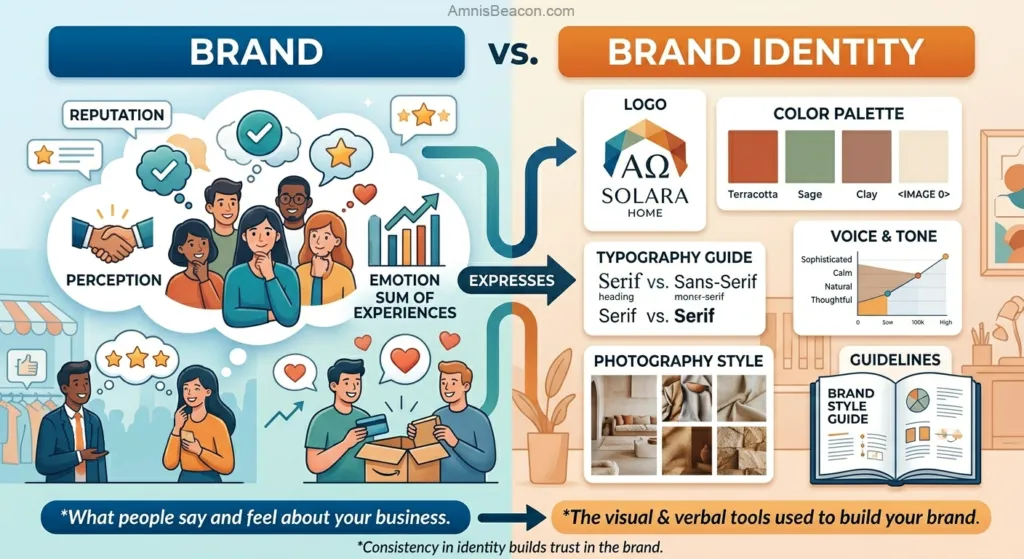
Brand identity is the deliberate, visual, and verbal expression of who your brand is.
It is the collection of elements you create and control – your logo, your colors, your fonts, your imagery, your voice, your messaging – designed to communicate a specific perception to a specific audience.
Think of it this way. Your brand is your reputation. Your brand identity is how you express and reinforce that reputation at every touchpoint.
A strong brand identity does not just make your business look good. It makes your business feel right to the people you are trying to reach. It creates recognition. It signals credibility. It builds the kind of trust that converts strangers into customers and customers into advocates.
A weak or inconsistent brand identity does the opposite – it creates confusion, dilutes trust, and makes it harder for your audience to choose you.
What Brand Identity Is Not
Before going deeper, it is worth clearing up a few common misconceptions.
Brand identity is not just a logo. A logo is one element of your identity. Without a surrounding system – colors, fonts, voice, guidelines – a logo is just a graphic.
Brand identity is not branding. Branding is the ongoing process of shaping perception. Brand identity is the toolkit you use to do it. One is the strategy. The other is the expression.
Brand identity is not static. Strong identities evolve over time as businesses grow, audiences shift, and markets change. The goal is intentional evolution – not constant reinvention.
Brand identity is not only visual. Many businesses invest in visuals and completely ignore their verbal identity – their voice, tone, messaging, and positioning. A complete brand identity system includes both.
The Core Elements of Brand Identity
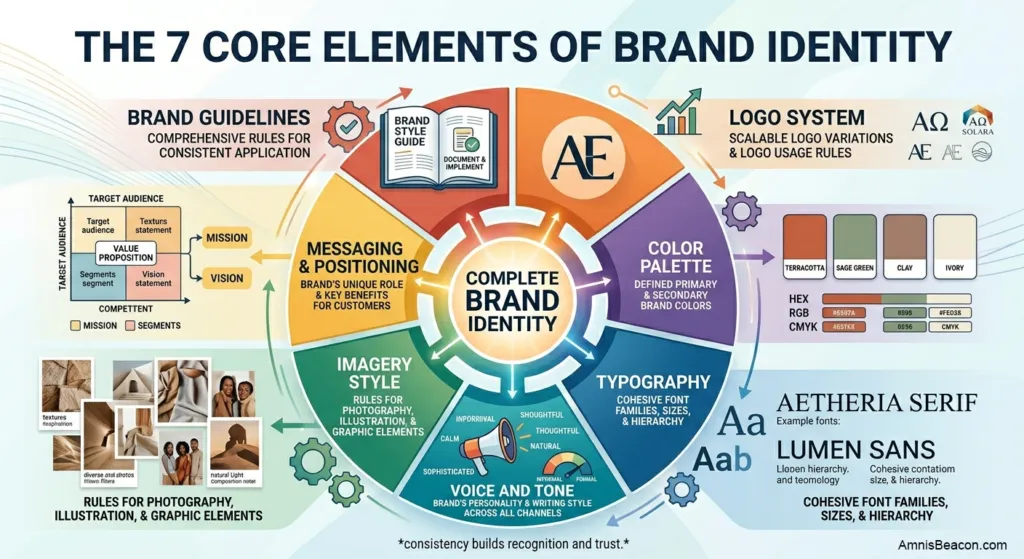
A complete brand identity is made up of several interconnected components. Each one plays a specific role. Together, they create a system that is greater than the sum of its parts.
Logo System
Your logo is the visual anchor of your brand identity. A well-designed logo system includes three versions: a primary logo (the full version), a secondary or stacked version, and an icon or mark (a simplified version for small spaces like social media profiles or favicons).
A strong logo is simple, scalable, and appropriate for your industry and audience. It is not designed to be trendy – it is designed to last.
Color Palette
Color is one of the fastest and most powerful brand signals available. Research shows that color alone can increase brand recognition by up to 80 percent.
A brand color palette typically includes a primary brand color, one or two secondary accent colors, and neutral tones for backgrounds and text. Each color should be chosen deliberately – based on color psychology, competitive differentiation, and the emotional response you want to trigger in your audience.
Your palette should also be defined with precision. Hex codes for digital use, RGB values for screens, and CMYK values for print. Consistency at this level is what separates professional brands from amateur ones.
Typography
Typography is often overlooked, but it does significant work. The fonts you choose communicate personality, formality, and tone before a single word is absorbed.
A serif font communicates tradition and authority. A clean sans-serif communicates modernity and clarity. A script font communicates elegance or creativity. The right typography aligns with your brand personality and appeals to your target audience.
Your typography system should include a primary heading font and a secondary body font. Two fonts, used consistently, are more powerful than six fonts used randomly.
Voice and Tone
Brand identity extends beyond the visual. How your brand communicates – the words it uses, the rhythm of its sentences, the level of formality, the presence or absence of humor – is a critical part of your identity.
Voice is your brand’s consistent character. It does not change. Tone shifts based on context – an email to a new client may be warmer and more conversational than a press release, but the underlying voice is the same.
Defining your brand voice answers questions your team will face every day: How do we write this caption? How do we respond to this comment? What does this email sound like? Clear answers to those questions produce consistent communication – and consistency builds trust.
Imagery and Photography Style
The images you use carry meaning that words sometimes cannot. Your imagery style – whether warm or cool, polished or candid, product-focused or lifestyle-driven – shapes perception before the audience consciously processes it.
Defining your imagery direction means creating a standard for the types of photos, illustrations, and graphics your brand uses. This ensures that every visual you publish reinforces your identity rather than contradicting it.
Messaging and Positioning
Your messaging is the verbal translation of your brand strategy. It includes your tagline, your value proposition, your elevator pitch, and the key messages you use across different audiences and contexts.
Positioning defines where you sit in the market relative to competitors – and why that position is the right one for your ideal customer. Clear positioning makes your marketing sharper, your sales conversations more confident, and your brand more memorable.
Brand Guidelines
Brand guidelines are the document that holds the entire system together. They define the rules – how to use the logo, which colors go where, which fonts at which sizes, how to write in the brand voice, what imagery is appropriate.
Without guidelines, even a well-designed identity will drift into inconsistency as your business grows. Guidelines are not bureaucracy – they are protection. They ensure that every person who touches your brand, inside or outside the business, represents it correctly.
Why Brand Identity Matters at Every Stage
Brand identity is not something you build once you are successful. It is something you build so that you can become successful.
Here is why it matters regardless of where you are in your journey.
For Startups and New Businesses
First impressions happen fast – and they are hard to reverse. A startup with a clear, professional brand identity signals credibility from day one. It tells potential customers, partners, and investors that you are serious, that you have thought about what you are building, and that you are worth their attention.
Without a clear identity, early-stage businesses often struggle to communicate what they do and why it matters. Unclear branding leads to unclear positioning – and unclear positioning makes every sale harder.
For Growing Businesses
As a business scales, more people touch the brand – employees, contractors, agencies, partners. Without a clear identity system and documented guidelines, consistency breaks down. Inconsistency creates confusion. Confusion erodes trust.
A strong brand identity gives growing teams a shared standard to work from. It makes decisions easier – “Does this fit our brand?” becomes a question anyone can answer.
For Established Businesses
Even businesses with years of market presence often have brand identity that has drifted or never been fully developed. Legacy visuals, outdated messaging, and inconsistent communication are all common – and all quietly damaging.
For established businesses, investing in brand identity often means strengthening and systematizing what already exists – not starting over. The goal is alignment between the quality of the work and the perception the brand creates.
For Public Figures and Influencers
Personal brands follow the same rules as business brands. A public figure or influencer with a clear, consistent identity – a recognizable visual style, a distinct voice, a clear positioning – builds an audience faster, commands more trust, and creates more opportunity than one who shows up inconsistently.
Your personal brand is always communicating something. The question is whether it is communicating what you intend.

How Brand Identity and Business Performance Are Connected
This is the part many people miss. Brand identity is not just a creative exercise – it has a direct impact on business outcomes.
Conversion rates improve when your brand communicates credibility clearly. People buy from brands they trust. A polished, consistent identity builds that trust before the conversation even starts.
Pricing power increases with a strong brand identity. When your brand communicates premium value through its visual and verbal presentation, customers expect to invest accordingly. The brand creates the context in which your price is evaluated.
Customer retention improves when people feel connected to a brand beyond the transaction. Identity creates belonging. Belonging creates loyalty.
Marketing efficiency improves when your brand has a clear identity. Every piece of content, every ad, every campaign builds on a consistent foundation – compounding recognition and trust over time rather than starting from scratch with each effort.
Referrals increase when customers can clearly articulate what you do and who you are for. A clear brand identity gives your audience the language to describe you accurately – which makes word-of-mouth marketing far more effective.
Signs Your Brand Identity Needs Work
Not every business knows when its brand identity is holding it back. Here are some clear signals.
You struggle to describe what makes your business different. Your visuals look inconsistent across platforms. Your website, social media, and printed materials do not feel like they belong to the same brand. Customers seem confused about exactly what you offer or who it is for. You attract the wrong clients – or not enough of the right ones. Your brand does not reflect the quality or level of your actual work.
Any one of these is a signal worth paying attention to. More than one is a clear indicator that brand identity work needs to happen.
Building a Brand Identity That Works: Where to Start
You do not need a massive budget to build a strong brand identity. You need clarity, intentionality, and consistency.
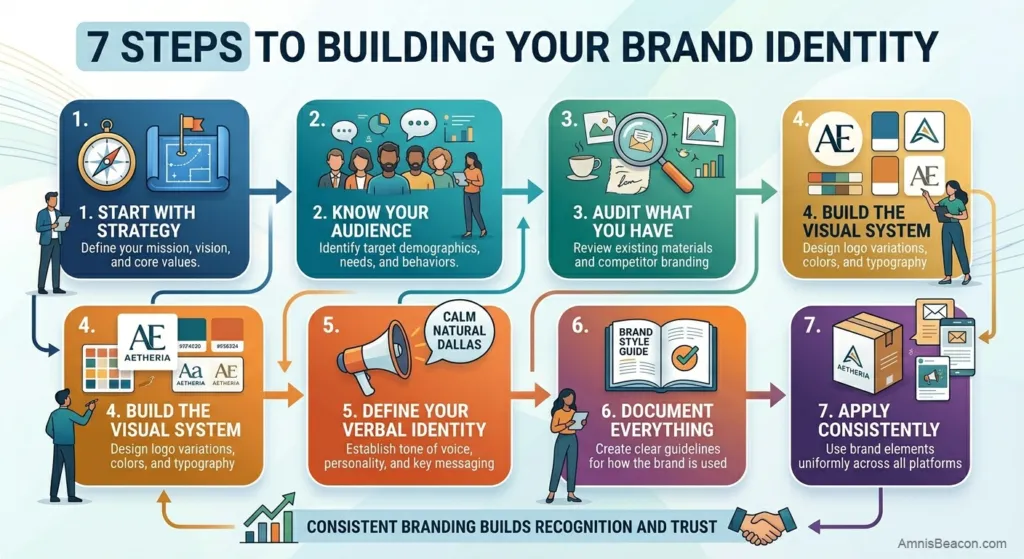
Start with strategy, not design. Before anything is designed, answer the foundational questions: Who are you? Who do you serve? What do you stand for? What makes you different? What do you want people to feel when they encounter your brand? The answers to these questions are the brief for everything that follows.
Know your audience deeply. Brand identity is not built in isolation – it is built for a specific person. Understand their psychology, their values, their aspirations, and what signals credibility to them. Your identity should speak their language.
Audit what you already have. Look honestly at your current visuals, messaging, and communication. What is working? What is inconsistent? What no longer reflects who you are? Start from an accurate picture of your current state.
Build the visual system. Logo, color palette, typography, imagery direction. Start with the fundamentals and build from there. Every element should be intentional and connected to your brand strategy.
Define your verbal identity. Write down your brand voice. Document your key messages, your positioning statement, and your value proposition. Give everyone on your team the same language to work from.
Document everything. Create brand guidelines – even a simple version. This is what protects your identity as your business grows and more people touch your brand.
Apply consistently. Your identity only works if it is applied consistently across every touchpoint – website, social media, email, proposals, packaging, presentations. Consistency is what turns an identity into recognition, and recognition into trust.
Final Thoughts
Brand identity is the foundation that every other part of your marketing is built on. Without it, even great products and services struggle to gain traction. With it, every marketing effort you make becomes more effective – because it builds on a consistent, credible foundation.
Understanding brand identity is not just about knowing the components. It is about understanding the role each one plays in building trust, driving recognition, and creating the kind of perception that turns your target audience into loyal customers.
The businesses and public figures that invest in understanding and building their brand identity do not just look better. They compete better. They grow faster. They attract the right people with less effort – because clarity is one of the most powerful advantages any brand can have.
If you are ready to build or strengthen your brand identity with strategy behind it, explore Amnis Beacon’s brand identity services or get started with the Brand Starter Kit.
Amnis Beacon specializes in brand identity and brand strategy consulting for businesses, public figures, and influencers. We combine analytics, psychology, and market intelligence to build brands that are credible, consistent, and built to grow.