

There is a brand you will never forget.
You know the one. You see a color and it comes to mind instantly. You hear a sound and you know exactly who it is. You read three words and you recognize the voice before you see the name.
That kind of recognition does not happen by accident. It is engineered – through intentional decisions, consistent execution, and a deep understanding of the people the brand is built to serve.
Most businesses never reach that level of recognition. Not because they lack quality, talent, or a great product. But because they never took the time to build a brand identity that earns a permanent place in the minds of their audience.
This guide is your roadmap for doing exactly that.
Why Most Brand Identities Fail to Stick
Before getting into how to build a memorable brand identity, it is worth understanding why so many fail to leave a lasting impression.
The most common reasons are not what most people expect.
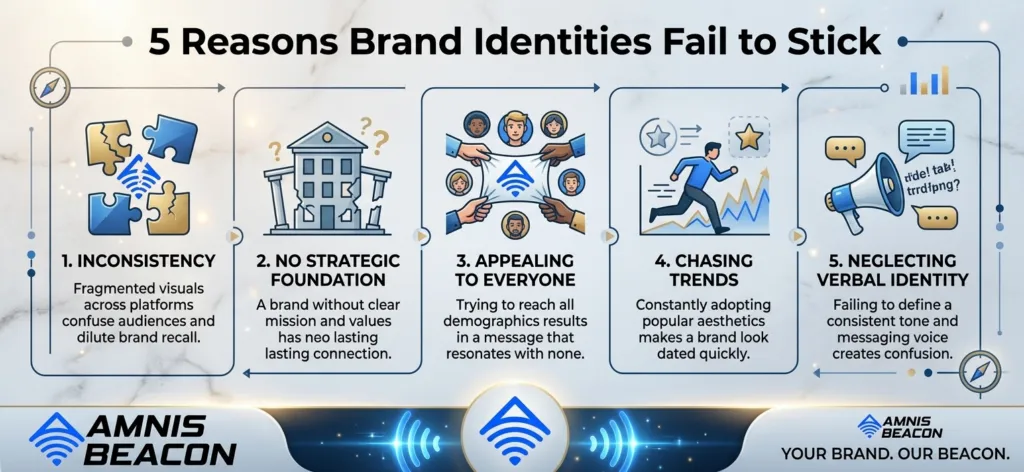
Inconsistency. The number one enemy of brand recognition is inconsistency. When your Instagram looks different from your website, and your website sounds different from your emails, your audience cannot build a reliable mental picture of who you are. Every time they encounter a version of your brand that feels different, the recognition resets.
No strategic foundation. Many brands are built visually without a strategy behind them. A logo is designed, some colors are picked, and the brand launches – without anyone ever defining the purpose, positioning, or personality that should drive every visual and verbal decision. The result is a brand that looks fine but does not connect.
Trying to appeal to everyone. A brand that is designed to appeal to everyone ends up resonating with no one. Specificity is what creates connection. When your audience sees your brand and thinks “this is exactly for me,” that is the result of deliberate, targeted identity work – not broad, safe design choices.
Chasing trends. Trends change. A brand built on what is popular right now will look dated fast – and rebranding resets the recognition you have already built. Memorable brands are built for longevity, not novelty.
Neglecting the verbal side. Visual identity gets most of the attention, but the verbal side – voice, tone, messaging, and positioning – is equally powerful. Brands that nail both create a complete, cohesive experience that is far harder to forget.
Step 1 – Build Your Strategic Foundation First
Every memorable brand identity starts before any design work begins. It starts with strategy.
Strategy answers the questions that design cannot. Who are you? Why do you exist beyond making money? Who are you serving – and what do they need to feel to trust you? What makes you different from every other option in your market? What do you want people to think, feel, and say when they encounter your brand?
These are not soft questions. They are the brief that every designer, copywriter, and marketer on your team will work from. Get them wrong – or skip them entirely – and every design decision that follows will be built on an unstable foundation.
Here are the strategic elements to define before anything else:
Brand purpose. The reason your brand exists beyond profit. Your purpose is the conviction behind the business – the deeper “why” that gives your brand meaning and makes it easier for the right people to connect with you.
Brand values. The principles that guide how you operate, communicate, and make decisions. Values are not words on a wall – they are the standards your brand is held to in every interaction.
Target audience. Not a demographic range. A specific person. Know their challenges, their aspirations, their values, and what signals credibility and trust to them. Your identity should speak directly to that person.
Brand positioning. Where you sit in the market relative to your competitors – and why that position is the right one for your ideal customer. Positioning is what makes your brand the obvious choice for a specific person, rather than just another option.
Brand personality. The human characteristics of your brand. Is it bold or understated? Warm or authoritative? Playful or serious? Personality shapes both visual and verbal decisions – and it is what makes a brand feel human and relatable.
Step 2 – Define Your Brand Voice
Voice is the personality of your brand expressed through language. It is how your brand sounds across every piece of communication – website copy, social media captions, emails, proposals, customer service responses.
A clearly defined brand voice does several things at once. It makes your communication consistent across every channel and every team member who writes on behalf of the brand. It makes your brand recognizable through language alone – before the audience even sees your visual identity. And it creates a sense of familiarity and trust over time, because your audience always knows what to expect from you.
To define your brand voice, start by describing your brand as if it were a person. What kind of person is it? How does it speak? What does it say – and what does it never say? What three to five words describe its character?
Then create a voice guide. Document the tone, the vocabulary, the sentence style, and the rules. Include examples of what your brand would and would not say. This becomes the verbal standard that every piece of communication is measured against.

Step 3 – Build a Visual Identity System That Works
Your visual identity is the most immediate expression of your brand. It is what people see first – and what they remember longest.
A memorable visual identity is not just a good-looking logo. It is a complete system, where every element is connected, intentional, and working together to communicate a single, clear impression.
Logo System
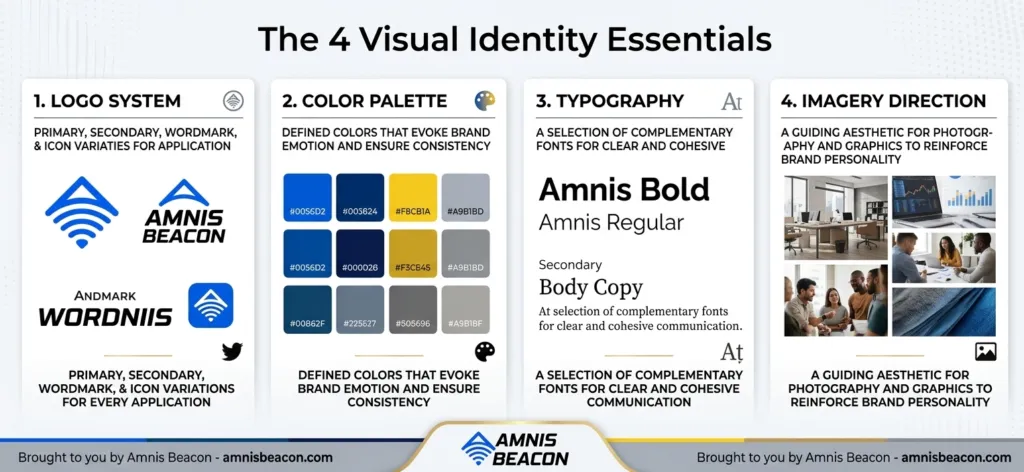
Design a logo system, not just a logo. Your system should include a primary logo (the full version used in most contexts), a secondary or horizontal version (for different layout needs), and an icon or mark (a simplified version for small spaces like profile images, favicons, and app icons).
Your logo should be simple enough to be recognizable at any size, versatile enough to work across every medium, and distinctive enough to stand apart from competitors in your space.
Color Palette
Your color palette is one of the most powerful recognition tools your brand has. Colors trigger emotion and association faster than any other visual element – and they are often what audiences remember most.
Choose colors that align with your brand personality, resonate with your target audience’s psychology, and differentiate you from the dominant colors in your competitive landscape. Define your palette with precision – hex codes, RGB values, and CMYK values – so that your colors are always reproduced accurately, regardless of the medium.
Limit your palette to one primary brand color, one or two secondary colors, and neutral tones. Restraint creates recognition. Variety creates confusion.
Typography
Your typography communicates personality before a single word is read. Choose fonts that align with your brand personality and create a clear visual hierarchy across all your materials.
A two-font system – one for headings and one for body text – is almost always enough. More than that and your materials start to feel inconsistent. Stick to your system across every touchpoint, every time.
Imagery and Photography Direction
Define the visual world your brand lives in. What kinds of images feel right – polished studio shots or natural lifestyle photography? Warm tones or cool and clean? People-focused or product-focused? Illustrated or photographic?
Your imagery direction ensures that every visual you publish, whether it is a website hero image or a social media post, reinforces the same impression. Inconsistent imagery is one of the fastest ways to dilute a strong brand identity.
Step 4 – Create Brand Guidelines
A brand identity without guidelines is a brand identity waiting to fall apart.
Guidelines are the rulebook that holds your entire system together. They document exactly how every element of your identity should be used – and how it should not be used. They answer the questions that will inevitably come up as your brand grows: Which colors go together? Which logo version goes on a dark background? How large does the logo need to be? What fonts do we use in presentations?
Without answers to those questions, every person who touches your brand will make their own decisions. Over time, those small variations compound into a brand that looks and feels inconsistent – even if the original design was strong.
Your brand guidelines do not need to be a 100-page document from day one. Start with the essentials: logo usage rules, color palette with values, typography system, imagery direction, voice and tone overview, and a few examples showing the brand applied correctly. Build from there as your business grows.
Step 5 – Apply Your Identity Consistently Across Every Touchpoint
Consistency is the mechanism that turns a brand identity into brand recognition – and brand recognition into trust.
Every touchpoint your audience encounters is an opportunity to reinforce your identity or dilute it. Your website, your social media profiles and content, your email communications, your proposals and presentations, your packaging, your signage, your team’s email signatures – all of it should feel unmistakably like your brand.
This sounds obvious. In practice, it requires discipline.
Audit every touchpoint your audience encounters and ask a single question: Does this feel like the same brand? If the answer is no, or even maybe, that is where consistency work needs to happen.
The brands that become unforgettable are not always the most creative ones. They are the most consistent ones. They show up the same way, every time, until that consistency builds a recognition so strong that it becomes automatic.

Step 6 – Connect Emotionally
Memorability is not just a function of repetition. It is a function of emotion.
The brands that people never forget are the ones that made them feel something. Safe. Inspired. Understood. Elevated. Part of something bigger than a transaction.
Emotional connection is not accidental – it is engineered into the brand strategy from the beginning. It comes from understanding your audience deeply enough to know what they are really looking for, and building a brand that delivers that feeling at every touchpoint.
Ask yourself: What do I want my audience to feel when they encounter my brand? Not what do I want them to think – what do I want them to feel? Then look at every element of your identity and ask whether it delivers that feeling.
Your color choices influence emotion. Your typography influences emotion. Your voice and messaging influence emotion. Your imagery influences emotion. When every element is aligned around the same emotional intention, the result is a brand that resonates at a level that is very difficult to forget.
Step 7 – Evolve Intentionally
Memorable brands are not frozen in time. They evolve. But they evolve with intention – not reactively, not impulsively, and not in response to every new trend.
The difference between a brand refresh and a rebrand is important. A refresh updates and refines – modernizing elements while maintaining the recognition that has already been built. A rebrand starts over – which means starting the recognition-building process over as well.
Most businesses should be refreshing, not rebranding. And most refreshes should be driven by a clear strategic reason – a shift in audience, a significant expansion of services, a merger or acquisition – not by boredom or trend-chasing.
When you evolve your brand identity, do it from a position of clarity. Know what you are keeping and why. Know what you are changing and why. Bring your audience along rather than surprising them. And document the updated standards so that the new version is applied as consistently as the original.
What Memorable Brand Identities Have in Common
Look at any brand that has become genuinely unforgettable – Apple, Nike, Patagonia, Airbnb, Glossier – and you will find the same qualities underneath the surface.
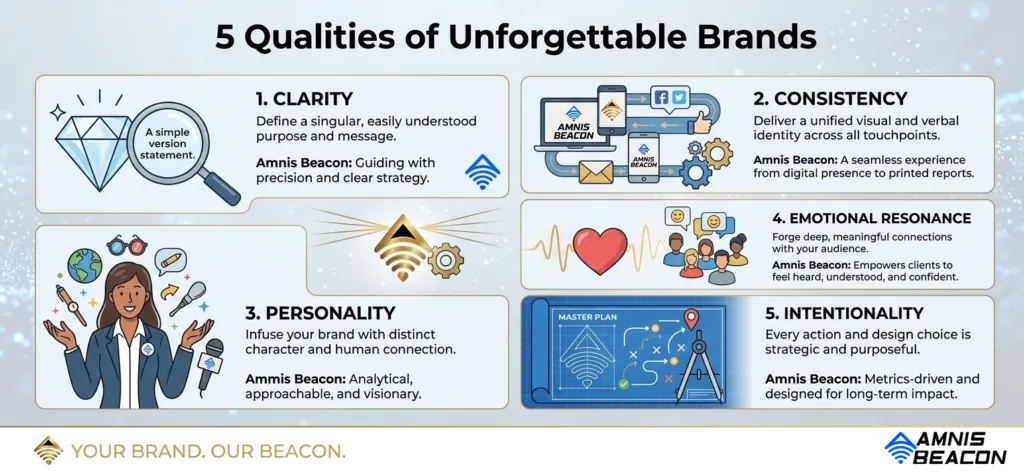
Clarity. They know exactly who they are and who they are for. There is no ambiguity in their positioning. Their audience knows immediately whether the brand is for them.
Consistency. They show up the same way across every channel, every campaign, every interaction. The experience is predictable – and predictability builds trust.
Personality. They feel human. They have a distinct voice and character that makes them recognizable through language alone, separate from any visual element.
Emotional resonance. They make people feel something. They create belonging, aspiration, or a sense of being understood – and those feelings keep people coming back.
Intentionality. Every element of their identity was chosen deliberately. Nothing is default. Nothing is accidental.
These are not qualities that require a massive budget. They require clarity of purpose, commitment to consistency, and a willingness to do the strategic work before the creative work.
Final Thoughts
Building a brand identity your customers will never forget is not about being the loudest, the flashiest, or the most design-forward brand in your market.
It is about being the clearest. The most consistent. The most intentional.
It is about knowing exactly who you are and who you serve – and showing up for those people the same way, every single time, until the recognition is so strong that forgetting you is simply not an option.
That kind of brand does not happen overnight. But it does happen – for businesses of every size, at every stage – when the strategic foundation is right and the execution is consistent.
If you are ready to build a brand identity that earns a permanent place in the minds of your audience, explore Amnis Beacon’s brand identity services or get started with the Brand Starter Kit.
Amnis Beacon specializes in brand identity and brand strategy consulting for businesses, public figures, and influencers. We combine analytics, psychology, and market intelligence to build brands that are credible, consistent, and built to grow.