

Most business owners make the same decision when they’re ready to build a website.
They look for someone who can make it look good.
They find a designer. They review a portfolio. They see colors and layouts and hero images that feel professional and expensive. They make the hire.
Six months later, the website exists. It looks exactly like the mockups. The colors are consistent. The typography is clean. The logo sits exactly where it should.
And the phone isn’t ringing.
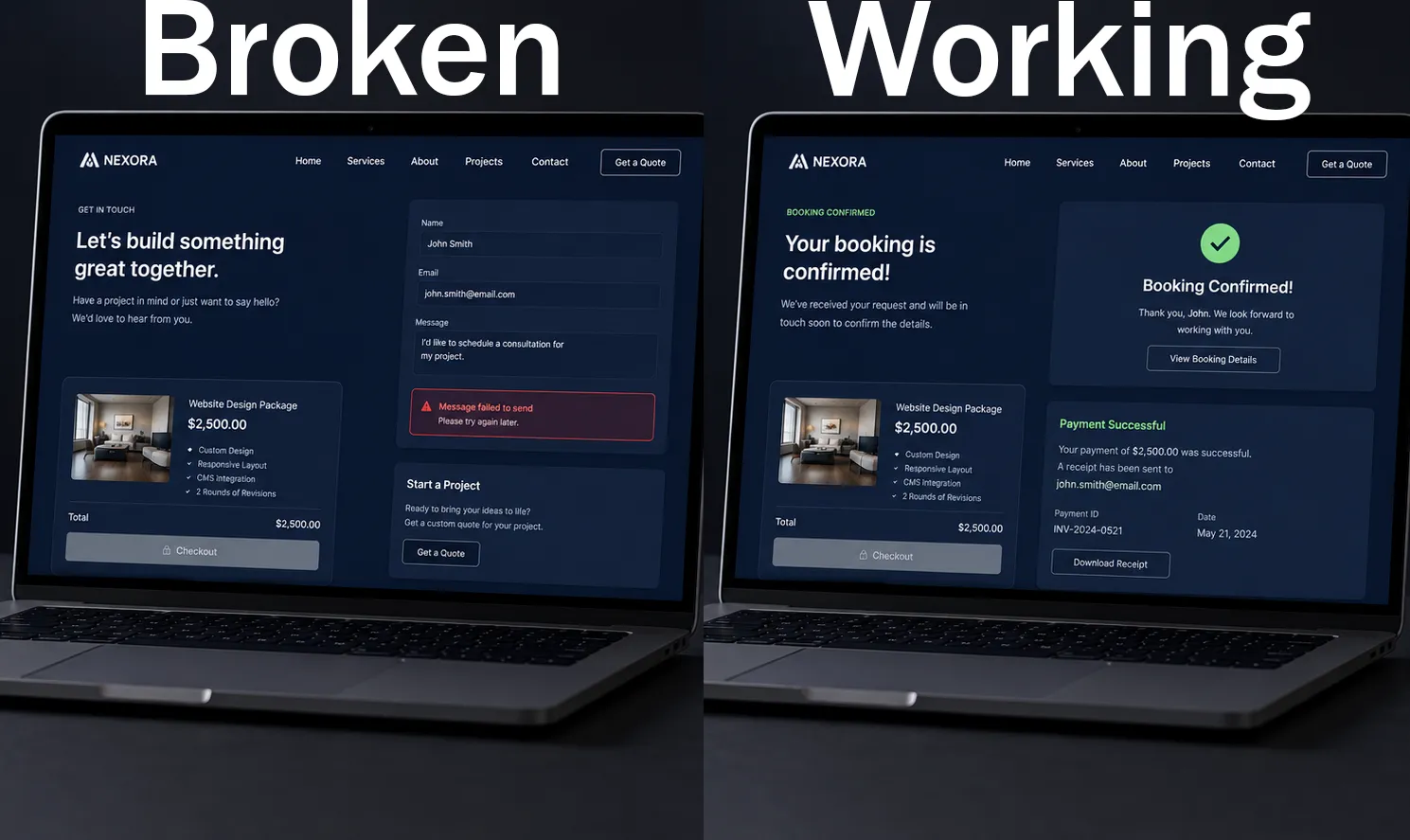
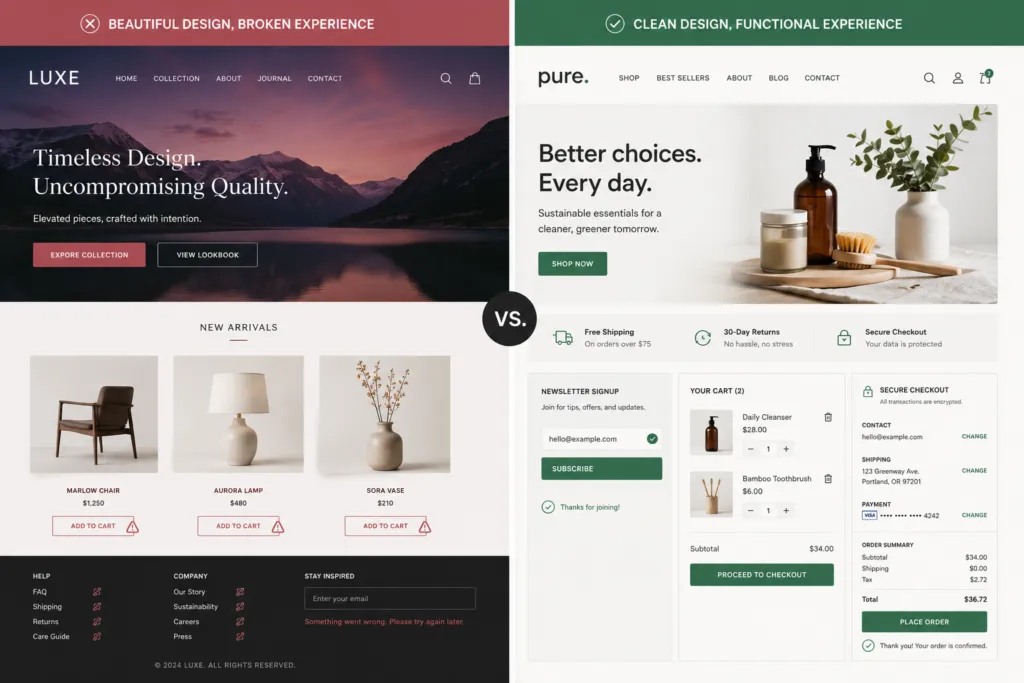
The contact form doesn’t send emails. The booking button goes nowhere. The cart adds products but the checkout never completes. The mobile version is broken on half the phones visitors use. The integration with their payment processor was never set up because the designer didn’t know how.
The website looks like a business.
It just doesn’t function like one.
The Brain Doesn’t Care What It Looks Like
Here’s something most people don’t want to hear.
Your customer’s brain makes a decision about your business in seconds. Not minutes. Seconds. And that decision isn’t based on your color palette or your font choice. It’s based on something far more primal.
Does this feel like it works?
The unconscious mind is constantly scanning for signals of competence and reliability. Not proof. Signals. And the fastest signal of incompetence a website can send is a broken experience.
A form that doesn’t submit. A button that doesn’t respond. A page that loads half its content and stops. A checkout that throws an error at the final step.
These aren’t minor inconveniences. They are trust destruction events.

Freud understood that the mind avoids unresolved tension. When something doesn’t work, tension spikes. The brain doesn’t think, how interesting, I wonder why this form isn’t working. It thinks, this business isn’t safe.
And it leaves.
Not loudly. Not with feedback. Quietly. Without trace. The same ghosting behavior that happens when a brand confuses someone or exhausts them happens when a website fails to function. The mind decides that engagement itself is the problem and removes itself from the situation.
You never know it happened. You just never hear from them.
What a Designer Builds and What a Developer Builds
This isn’t about who is better.
It’s about what the job actually requires.
A designer’s expertise is visual. They understand hierarchy, spacing, color theory, typography, and how to create something that communicates a feeling. That skill is real and valuable. A badly designed website communicates distrust before anything else.
But design is the surface.
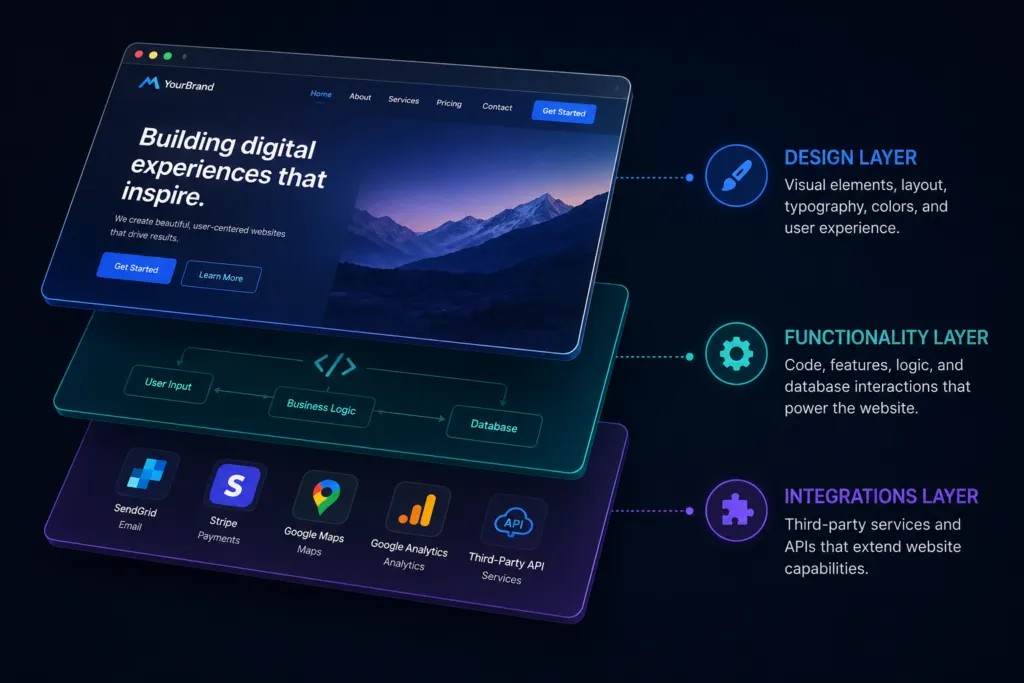
A developer’s expertise is functional. They understand how data moves through a system, how a form connects to an email service, how a booking widget integrates with a calendar, how a payment gateway processes a transaction securely, how a database stores and retrieves information, and how a website behaves across every browser, device, and screen size a real person might use.

When someone lands on your website and submits their information, that information has to go somewhere. It has to be received, stored, and acted upon. When someone adds a product to a cart, a series of calculations has to happen in real time, inventory, pricing, taxes, shipping, payment authorization, confirmation. When someone books an appointment, that booking has to talk to your calendar, send a confirmation email, block the time slot, and update availability instantly.
None of that is design.
All of it is engineering.
And none of it is optional if your website is supposed to do anything other than exist.
The Illusion of Functionality
Here is where the real damage happens.
AI website builders and template-based platforms have made it possible to produce a website that looks like it has every feature imaginable, without any of those features actually working.
You can install a page with a cart icon. The icon looks exactly like a functional store. Click it and nothing happens.
You can add a contact form. It looks professional. It has fields and a submit button. But it was never connected to an email service, so every submission disappears into nothing.
You can add a booking widget. It has calendar graphics and time slots. But it was never integrated with any actual scheduling system, so customers think they’ve booked but nothing was recorded.

This is what happens when a website is built by someone who understands what things should look like but not how they need to work.
The brain reads this immediately. Not consciously. Unconsciously. There is a specific feeling when you interact with something that looks functional but isn’t. It’s the same feeling you get when you push a door that says pull. A small jolt. A signal that something is off. That signal doesn’t go away when you move to the next page. It colors everything that follows.
That jolt is your customer’s trust taking its first hit.
Most of them won’t tell you. They’ll just leave.
What a Business Website Actually Needs
Let’s be specific.
Because the gap between what a website looks like and what it needs to do is the gap between a business that generates revenue and a business that just has an online presence.
Contact and Lead Capture. Every form on your website needs to connect to something. An email inbox, a CRM, a notification system. The data needs to arrive where you can act on it. If a potential client fills out your contact form at 11pm and that submission disappears, that lead is gone forever.
Booking and Scheduling. If your business operates on appointments, consultations, or reservations, your website needs a booking system that actually works. Not one that looks like a booking system. One that blocks time on a real calendar, sends real confirmation emails, and prevents double-booking.
Ecommerce and Payments. Selling anything online requires a real payment infrastructure. Stripe, PayPal, Square, WooCommerce – these aren’t plug-and-play by default. They require configuration, testing, security compliance, and proper connection to your bank account. A developer sets this up correctly. A template generates the visual shell of it.
Mobile Performance. Over 60 percent of website traffic comes from mobile devices. A website that looks perfect on a laptop and breaks on a phone isn’t a minor issue. It’s a primary traffic problem. Responsive development isn’t a feature. It’s a baseline requirement that requires actual technical work to execute correctly.
Third-Party Integrations. Your website doesn’t exist alone. It needs to talk to your email marketing platform, your CRM, your inventory system, your delivery partners, your analytics. Grubhub. DoorDash. Stripe. Mailchimp. Google Analytics. These integrations don’t happen automatically. They require a developer who understands APIs, authentication, data formatting, and error handling.
Security. SSL certificates, secure form handling, data protection, GDPR and CCPA compliance, protection against injection attacks. These aren’t optional extras for businesses that take security seriously. They are minimum requirements for any business that collects customer information. A designer doesn’t configure these. A developer does.
The Lender Problem
There is a conversation most web designers never mention and most business owners don’t think about until it costs them something expensive.
Banks and lenders evaluate your online presence before they evaluate your application.
Not always formally. Not always with a checklist. But the person reviewing your loan, your line of credit, your grant application, your partnership proposal – they will look at your website. And what they’re looking for isn’t a color scheme.
They’re looking for operational signals.
Does this business look real? Does it look active? Does it look functional? Does the experience of visiting this website communicate that this is a legitimate, operating business that takes its infrastructure seriously?

A broken contact form communicates negligence. A non-functional booking system communicates operational immaturity. A website built on a free template with placeholder content communicates that the business hasn’t invested in itself.
None of that creates lender confidence.
A website built by a developer who understands that every element has to function correctly communicates the opposite. It communicates that this business is operational, competent, and credible at its most basic level of digital presence.
That signal travels further than most people realize.
Why This Matters More Now Than It Ever Did
The market is saturated with websites that look professional.
AI can generate a beautiful website in minutes. Templates can produce something polished in an afternoon. The visual bar has effectively collapsed because anyone can now produce something that looks like a real business website.
Which means visual professionalism no longer differentiates you.
Functionality does.
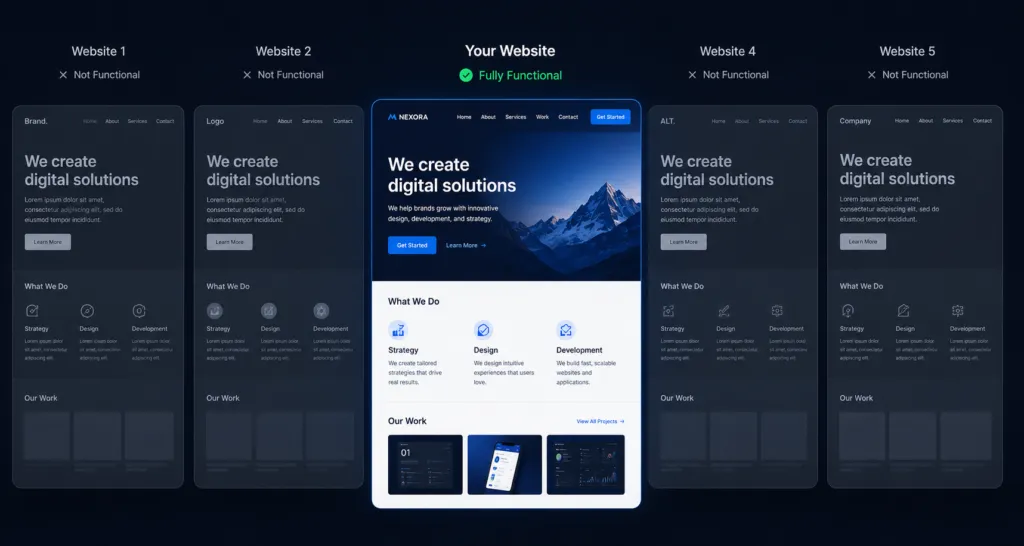
When every competitor has a website that looks similar to yours, the experience of using your website becomes the differentiator. Does it load fast? Does the form work? Does the checkout complete? Does the booking actually appear in the calendar? Does the mobile version behave correctly?
These are the moments where customers decide whether you’re a real business or a real-looking business.
The decision is made before logic arrives. Before your customer consciously evaluates your pricing, your services, or your reputation. It’s made in the seconds when they try to do something and either it works or it doesn’t.
That’s where trust is built or destroyed.
And trust, as we know, is not a feeling. It’s a shortcut. The brain is looking for the path that requires the least amount of vigilance. A website that functions correctly removes the need for vigilance. A website with broken features activates it.
Once vigilance is activated, you’re not closing that customer. You’re managing their suspicion.
The Real Question
The question isn’t whether your website looks good.
The question is whether your website works.
Not whether it could work in theory. Whether it works right now, today, on a phone, from a customer who has never heard of you and will not give you a second chance if the first experience fails them.
A designer can make it look like the answer is yes.
Only a developer can make sure it actually is.

Your website is not a brochure. It is an operational system that runs your business while you are not watching. It processes inquiries, captures leads, accepts payments, books appointments, and represents your business to every person who searches for what you do.
It either does those things reliably or it doesn’t.
There is no version of a beautiful, broken website that grows a business.
There is only a business that looks ready and one that is.
Amnis Beacon builds websites that function as complete business systems, not just digital storefronts. Every element is built to work, not just to look like it works.