


Most businesses think of public relations as something reserved for big corporations with dedicated PR teams and media budgets. Something you graduate into once you are already successful.
That thinking is backwards.
Public relations is one of the most powerful tools available for shaping how your brand is perceived – and it is available to businesses, public figures, and influencers at every stage. Used correctly, PR does something that paid advertising cannot: it builds credibility through third-party validation.
Anyone can pay to put their message in front of an audience. But when a journalist covers your story, when a podcast host invites you to speak, when an industry publication features your expertise – that is earned. And earned credibility is worth far more than bought attention.
This guide breaks down the basics of public relations, how it connects to brand identity, and how to start using it strategically to shape the perception of your brand.
What Public Relations Actually Is
Public relations is the strategic management of communication between your brand and the public.
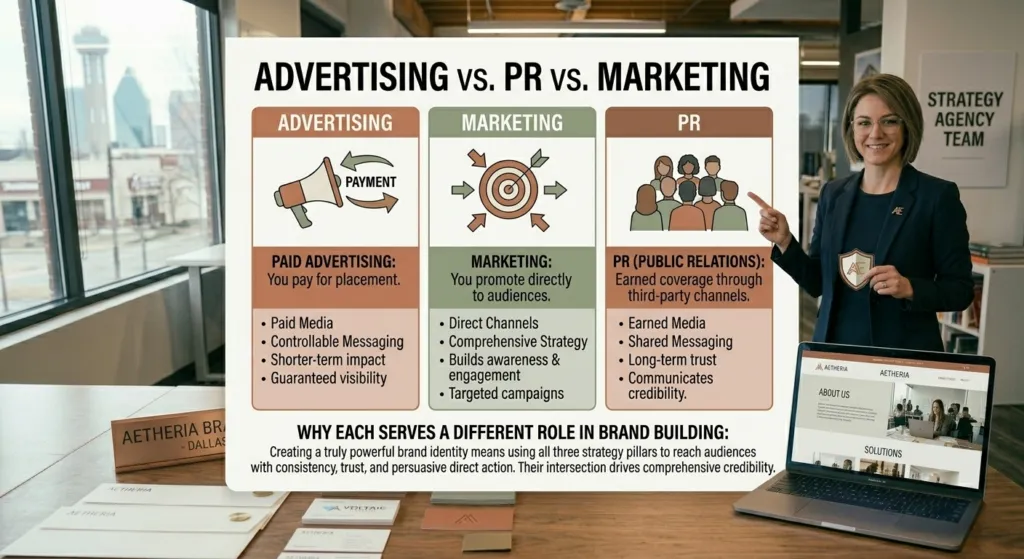
It is not advertising. It is not marketing in the traditional sense. PR is about influencing perception through channels you do not own and do not pay for directly – media coverage, editorial features, podcast appearances, speaking engagements, community involvement, and the way your brand shows up in public conversations.
The goal of PR is to shape the narrative around your brand. To ensure that when people encounter information about you – from sources outside your own channels – that information reinforces the perception you are intentionally building.
Done well, PR accelerates trust. It places your brand in front of new audiences through voices they already trust. It validates your expertise, your credibility, and your positioning in ways that self-promotion simply cannot replicate.
Done poorly – or not done at all – PR becomes a gap in your brand strategy. A gap that competitors will fill.
How PR and Brand Identity Work Together
Brand identity and public relations are more connected than most people realize.
Your brand identity defines who you are, what you stand for, and how you want to be perceived. PR is one of the primary mechanisms through which that perception is built and reinforced in the minds of people who have not yet encountered your brand directly.
Think of your brand identity as the message. PR is one of the most credible distribution channels for that message.
When your PR efforts are aligned with your brand identity, every piece of coverage, every interview, every feature reinforces the same impression. Your positioning becomes clearer. Your credibility grows. Your audience expands through channels they trust.
When PR and brand identity are not aligned – when the story being told in the press does not match the brand being presented on your website – it creates a disconnect that confuses your audience and dilutes the trust you are trying to build.
This is why PR strategy and brand strategy need to work from the same foundation. The same purpose, values, positioning, and personality that drive your visual and verbal identity should also drive every public-facing communication your brand produces.
The Core Components of a PR Strategy
You do not need a PR agency to start building a strategic public relations presence. But you do need to understand the components that make up an effective PR approach.
Brand Narrative
Your brand narrative is the story of your brand – who you are, why you exist, what you have built, and where you are going. It is the foundation of every PR effort.
A compelling brand narrative is not a history lesson. It is a story with stakes, purpose, and relevance to your audience. It answers the question that every journalist, podcast host, and event organizer is quietly asking: why should my audience care about this?
Your narrative should be clear, consistent, and aligned with your brand identity. It should reflect your positioning, communicate your values, and give people a reason to pay attention.
Key Messages
Key messages are the specific points you want every piece of PR coverage to communicate. They are the three to five ideas that you want your audience to walk away with after every interview, every feature, and every public appearance.
Key messages keep your communication focused. Without them, interviews drift, coverage becomes inconsistent, and the cumulative effect of your PR efforts is diluted. With them, every touchpoint reinforces the same core impression.
Your key messages should be grounded in your brand strategy. They should reflect your positioning, speak directly to your target audience, and differentiate you from competitors in your space.
Media Relations
Media relations is the practice of building relationships with journalists, editors, bloggers, and content creators who cover topics relevant to your brand.
It starts with understanding who your audience reads, watches, and listens to – and then identifying the specific journalists and publications that reach them. From there, it is about building genuine relationships, providing value (through expert commentary, story ideas, and data), and becoming a trusted source that media professionals return to.
Pitching media is a skill. A strong pitch is short, relevant, and clearly answers the question “why does this matter to my readers right now?” It is not a press release pasted into an email. It is a specific, timely story idea tailored to a specific journalist’s beat and audience.
Press Materials
Press materials are the documents that support your PR efforts. They give journalists, event organizers, and podcast hosts the information they need to cover your brand accurately and compellingly.
The core press materials every brand should have include:
- A media kit – an overview of your brand, your story, your expertise, and your key messages, presented in a clean, professional format
- A brand bio – a concise, compelling summary of who you are and what you do, written in third person, in multiple lengths (short, medium, and full)
- A headshot – a high-quality, professional photo that reflects your brand identity
- Press release templates – pre-formatted documents for announcing news, launches, partnerships, or milestones
All press materials should be visually consistent with your brand identity and verbally consistent with your brand voice. They are a direct reflection of your brand – and they will often be a journalist’s first impression of you.
Thought Leadership
Thought leadership is the practice of building authority and credibility by consistently sharing expertise, perspective, and insight in your field.
It is one of the most powerful PR strategies available – and one of the most accessible. Thought leadership does not require a publicist or a media budget. It requires clarity of perspective and consistency of output.
Thought leadership shows up in many forms: contributed articles in industry publications, guest posts on relevant blogs, speaking at conferences and events, appearing on podcasts, participating in panel discussions, and sharing expert commentary in media coverage.
The key is consistency and genuine expertise. Thought leadership that is shallow, generic, or clearly self-promotional damages credibility rather than building it. The brands and public figures that build real authority through thought leadership are the ones who show up consistently with perspectives that are specific, grounded, and genuinely useful to their audience.

PR for Different Brand Types
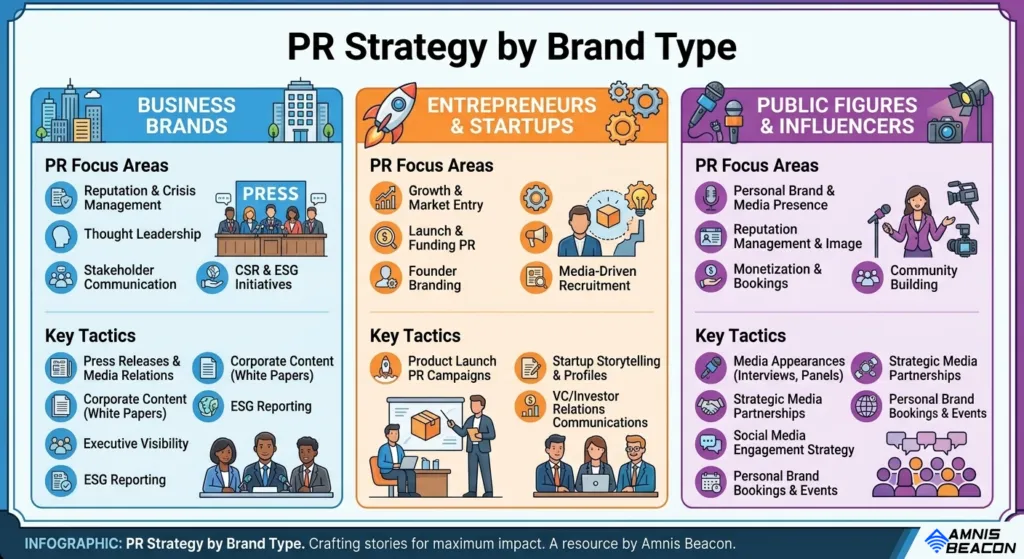
The fundamentals of PR are the same regardless of your brand type – but the application looks different depending on who you are and who you serve.
For Businesses
For business brands, PR is primarily about building credibility and visibility in the markets you serve. The goal is to be recognized as a trusted, authoritative voice in your industry – so that when your ideal customer is ready to make a decision, your name is already familiar and trusted.
Business PR focuses on industry media, trade publications, local business press, and the channels your target customers pay attention to. Case studies, data, and expert commentary are particularly powerful – they demonstrate results and expertise in a way that is highly credible to a business audience.
For Entrepreneurs and Startups
For entrepreneurs, personal brand and business brand PR are often intertwined. Building your own visibility as a founder – your story, your expertise, your perspective – directly builds the credibility of your business.
Startup PR often focuses on the origin story, the problem being solved, and the vision for the future. Investors, customers, and partners are all paying attention to how a founder shows up publicly – and a strong PR presence signals that the business is serious and worth watching.
For Public Figures and Influencers
For public figures and influencers, PR is about managing and shaping the narrative around their personal brand. Media presence, interview strategy, crisis communication, and message consistency are all critical.
Public figures face a unique challenge: they have less control over the narrative than a business brand does. PR strategy for public figures focuses on being proactive – building a strong, clear, positive narrative before others build one for you.
Managing Brand Reputation Through PR
Reputation management is one of the most important – and most overlooked – functions of public relations.
Your brand reputation is not just what you say about yourself. It is the aggregate of everything that is said about you – by customers, media, competitors, and the public. PR gives you tools to actively shape that aggregate rather than simply reacting to it.
Proactive reputation management means consistently putting positive, accurate, credible information about your brand into the world – through media coverage, thought leadership, community involvement, and strategic communication. The more positive content exists about your brand, the more resilient your reputation becomes.
Reactive reputation management – often called crisis communication – is what happens when something goes wrong. A negative review goes viral. A misquote gets picked up by media. A business decision is misunderstood publicly.
How your brand responds in those moments matters enormously. The brands that navigate reputation challenges well are the ones that respond quickly, transparently, and from a position of clear values. They acknowledge the issue, take responsibility where appropriate, communicate what they are doing to address it, and stay consistent with their brand voice throughout.
The brands that do it poorly are the ones that go silent, get defensive, or respond in a way that contradicts their stated values. Those responses compound the damage.
Having a basic crisis communication plan before you need one – clear decision-making authority, a response framework, and pre-approved messaging for common scenarios – is one of the most valuable investments any brand can make.
Common PR Mistakes to Avoid
Understanding what not to do is just as valuable as knowing what to do.
Treating PR as a one-time campaign. PR is not a launch strategy. It is an ongoing practice. Brands that only pursue PR around a specific launch or announcement miss the compounding benefits of consistent, long-term media presence.
Pitching without a story. “We launched a new product” is not a story. “We solved a problem that has frustrated our customers for years – here is how and why it matters” is a story. Always lead with the narrative, not the announcement.
Targeting the wrong media. Coverage in a publication your ideal audience does not read is vanity, not strategy. Know exactly who you are trying to reach and focus your efforts on the channels that reach them.
Ignoring brand alignment. PR that generates coverage misaligned with your brand positioning can actually do more harm than good. Every piece of coverage should reinforce – not contradict – the perception you are building.
Waiting for perfection. Many businesses put off PR because they feel they are not ready – the website is not finished, the brand is not polished enough, the product is not perfect. PR builds the perception that attracts the opportunities that fund the polish. Start before you feel ready.
Neglecting owned channels. Your website, blog, social media, and email list are the foundation that PR coverage drives people back to. If those owned channels do not reflect a strong, consistent brand identity, media coverage will not convert into the results you are looking for.

How to Start Building a PR Presence for Your Brand
You do not need an agency retainer to start. You need a strategy, a clear narrative, and consistent effort.
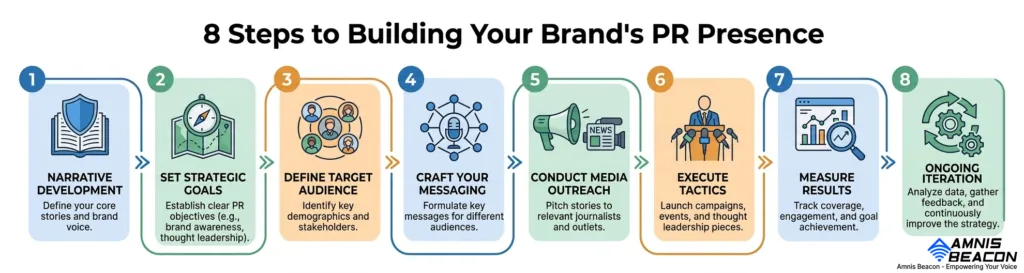
Step 1 – Clarify your brand narrative. Before you pitch anyone, know your story. Who are you, why does it matter, and why should anyone care right now? Get that story down to a clear, compelling two to three paragraph summary.
Step 2 – Define your key messages. Identify the three to five ideas you want every piece of coverage to communicate. These become the anchor for every interview, pitch, and public appearance.
Step 3 – Build your press materials. Create a media kit, a brand bio in multiple lengths, a professional headshot, and a press release template. Make them visually and verbally consistent with your brand identity.
Step 4 – Identify your target media. Research the publications, podcasts, blogs, and events your target audience pays attention to. Build a list of specific journalists, editors, and hosts who cover topics relevant to your brand.
Step 5 – Start with warm connections. Your first media opportunities will often come through people who already know you – former colleagues, mutual connections, community members. Start there before moving to cold outreach.
Step 6 – Pitch with specificity and relevance. Every pitch should be tailored to the specific person you are sending it to. Reference their work. Explain why your story is relevant to their audience right now. Make it easy to say yes.
Step 7 – Build thought leadership consistently. Start contributing – articles, podcast pitches, speaking applications, expert commentary. One piece of thought leadership content per month is enough to begin building a presence. Consistency matters more than volume.
Step 8 – Track and refine. Monitor your coverage, track which pitches get responses, and refine your approach based on what is working. PR is iterative – the brands that get the best results are the ones that treat it as a process, not a project.
Final Thoughts
Public relations is not a luxury reserved for big brands with big budgets. It is a strategic tool that is available to every business, entrepreneur, and public figure willing to invest the time and intention to use it well.
When PR is aligned with a strong brand identity and executed consistently, the results compound. Coverage builds awareness. Awareness builds familiarity. Familiarity builds trust. Trust drives decisions. And a brand with that kind of credibility does not just grow – it leads.
The basics are not complicated. A clear narrative, consistent key messages, strong press materials, targeted media relationships, and a commitment to showing up as a genuine thought leader in your space – these are the foundations that every memorable brand presence is built on.
Start there. Build from there. And let your brand become the story people cannot stop telling.
If you are ready to build a brand with the strategic foundation and identity to support a powerful PR presence, explore Amnis Beacon’s brand strategy and identity services or get in touch to start a consultation.
Amnis Beacon specializes in brand identity and brand strategy consulting for businesses, public figures, and influencers. We combine analytics, psychology, and market intelligence to build brands that are credible, consistent, and built to grow.