

The rules of public relations have changed.
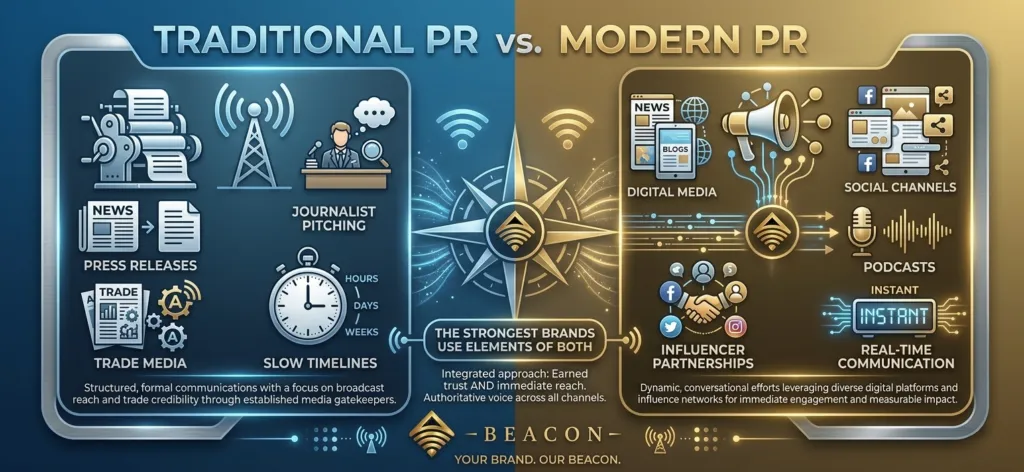
The strategies that built brand reputations a decade ago – press releases blasted to generic media lists, formal pitch letters sent cold to journalists, waiting months for a feature in a trade publication – those tactics still exist. But they no longer define what effective PR looks like.
Modern PR is faster, more direct, more digital, and more integrated with brand strategy than it has ever been. It includes influencer partnerships, digital media coverage, social media presence, podcast appearances, community building, and real-time reputation management – all working together to shape how your brand is perceived.
And the brands that understand how to use modern PR strategically are building brand identities that are not just recognized – they are trusted, sought out, and talked about.
This guide breaks down what modern PR actually looks like, how it connects to brand identity, and how to use today’s most effective PR strategies to build a brand that stands out and lasts.
Why Modern PR Is Different
Traditional PR was built around a simple model: get your story into the hands of journalists, and let them distribute it to their audiences.
That model still has value. But it no longer captures the full picture of what PR means today.
The media landscape has fundamentally shifted. The number of journalists has declined. The number of publications has exploded – from major digital outlets to niche blogs, newsletters, and social channels with highly engaged followings. Audiences have fragmented. Trust in traditional media has shifted toward individual voices – creators, experts, peers, and people with direct experience.
At the same time, brands now have direct access to their audiences in ways that were not possible before. A post on LinkedIn, a story on Instagram, a thread on X – these are all PR channels. And the brands that use them strategically are shaping their own narratives rather than waiting for someone else to tell their story.
Modern PR is not one channel or one tactic. It is a coordinated approach that spans earned media, owned channels, and strategic partnerships – all aligned around a clear brand identity and a consistent narrative.
The Foundation – Brand Identity First
Before any PR strategy – traditional or modern – can work effectively, the brand identity has to be clear.
This is the mistake many businesses make. They pursue PR coverage before they know what story they are telling. They pitch to media before they have defined their positioning. They show up on podcasts before they have developed a clear, consistent brand voice.
The result is coverage that is inconsistent, messaging that drifts, and a public perception that does not align with the brand they are actually trying to build.
Modern PR amplifies your brand. Which means it amplifies whatever is already there – clarity or confusion, credibility or inconsistency. Getting the brand identity right before scaling PR efforts is not optional. It is the foundation that determines whether PR creates compounding returns or compounding confusion.
Your brand identity needs to answer three questions before any PR strategy begins:
- Who are you and what do you stand for?
- Who is your audience and what do they need to feel to trust you?
- What is the single most important thing you want to be known for?
With clear answers to those questions, every PR effort – every pitch, every interview, every post, every partnership – reinforces the same impression. Without them, every PR effort pulls in a different direction.
Modern PR Strategy 1 – Digital Media and Online Publications
Digital media has expanded the PR landscape enormously. Where traditional PR was largely limited to print, broadcast, and a handful of major online outlets, modern PR has thousands of potential placements – from major digital publications to highly targeted niche sites with loyal, engaged readerships.
For brand identity building, niche digital media is often more valuable than broad national coverage. A feature in a publication that your exact target audience reads every day is worth far more than a passing mention in a general-interest outlet with millions of readers who are not your customer.
The approach to digital media pitching follows the same core principles as traditional media relations – a compelling story, a relevant angle, a targeted pitch – but moves faster and requires a stronger understanding of the digital content landscape.
SEO is also a factor that traditional PR never had to consider. Digital coverage that includes links back to your website builds domain authority and drives organic search traffic – giving earned media a long-tail value that print coverage cannot deliver.
When pursuing digital media coverage, focus on relevance over reach. Identify the publications your target audience actually reads. Study the specific writers who cover topics in your space. Pitch angles that are genuinely useful or interesting to their readers – not just announcements that serve your business.

Modern PR Strategy 2 – Podcast Appearances
Podcasts have become one of the most powerful PR channels available – and one of the most underutilized by brands at the growth stage.
There are over 4 million podcasts globally. Many of them have small but highly engaged, highly targeted audiences – exactly the kind of audience that builds brand credibility most effectively.
A podcast appearance gives you something that most PR formats cannot: unedited, long-form access to an engaged audience that has already opted in to hear from someone they trust. You are not competing for attention with the next story. You have the floor for 30 to 60 minutes. That is an extraordinary opportunity to communicate your brand narrative, establish your expertise, and build genuine connection with a new audience.
Podcast PR strategy starts with identifying shows that reach your target audience and align with your brand positioning. A business strategy podcast, an entrepreneurship show, an industry-specific series – the more directly relevant the audience, the more valuable the appearance.
Your pitch to podcast hosts should be concise and specific. Why are you a relevant guest for their audience? What specific topic or perspective can you bring that their listeners will find genuinely useful? Make it easy for the host to see the value before they respond.
Prepare for every appearance with your key messages in mind. Know the three to five points you want to communicate. Stay aligned with your brand voice. And treat every appearance as a brand touchpoint – because it is.
Modern PR Strategy 3 – Social Media as a PR Channel
Social media is not just a marketing channel. Used strategically, it is one of the most powerful PR tools available to modern brands.
The distinction matters. Marketing on social media promotes your products and services. PR on social media shapes perception, builds credibility, and manages narrative – often in real time.
Here is what social media PR looks like in practice:
Thought leadership content. Sharing genuine expertise, perspective, and insight positions your brand as a credible voice in your space. Not promotional content – substantive content that demonstrates what you know and how you think.
Media and coverage sharing. When your brand earns coverage – a feature, an interview, a mention – amplifying it through your social channels extends the reach of that earned credibility to your own audience.
Real-time narrative management. Social media is where narratives form quickly. Brands that are active, responsive, and consistent on social channels have far more ability to shape their narrative than brands that show up inconsistently.
Community engagement. The brands that build the strongest social media PR presence are not just broadcasting – they are participating. Responding to comments, engaging in industry conversations, acknowledging their community. That level of presence builds the kind of authenticity that no press release can manufacture.
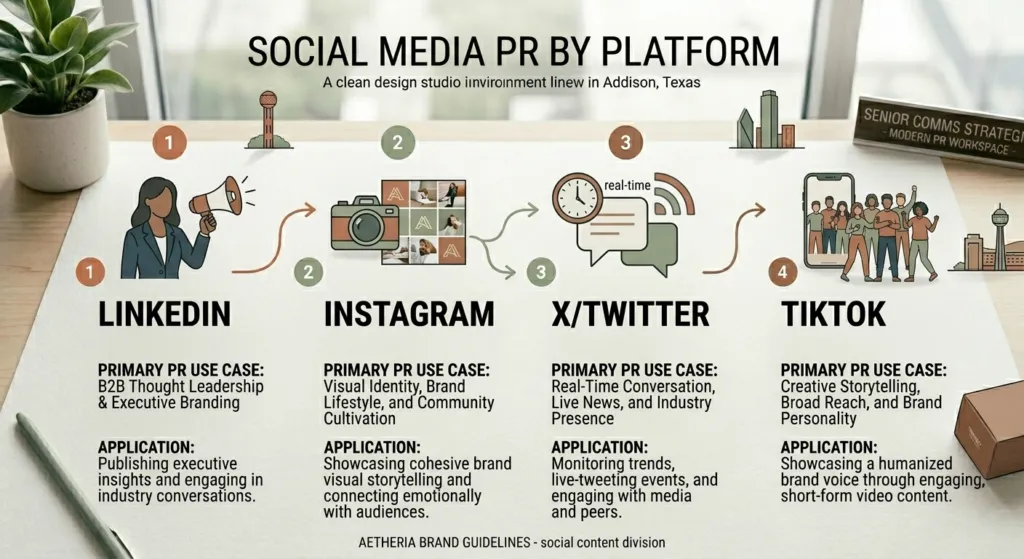
The platform matters. LinkedIn is the primary channel for B2B brand credibility and thought leadership. Instagram builds visual brand identity and lifestyle association. X (formerly Twitter) is where real-time industry conversations happen. Choose the platforms where your audience is most active and focus your presence there.
Modern PR Strategy 4 – Influencer and Creator Partnerships
One of the most significant shifts in modern PR is the rise of influencer and creator partnerships as a credibility-building strategy.
Traditional PR relied on journalists and editors as the gatekeepers of credibility. Modern PR recognizes that credibility now flows through a much wider range of voices – industry experts with large LinkedIn followings, niche content creators with deeply loyal audiences, community leaders who are trusted by exactly the people you are trying to reach.
Influencer partnerships for brand identity building are different from influencer marketing for direct sales. The goal is not immediate conversion – it is association and credibility. Being seen in the right company, by the right audience, with the right context.
The most effective influencer PR partnerships for brand identity share a few characteristics. The creator’s audience overlaps significantly with your target audience. The creator’s values and positioning are aligned with your brand. The partnership feels natural and genuine – not transactional. And the content produced reflects your brand identity accurately and consistently.
Micro-influencers – creators with smaller but highly engaged, niche audiences – are often more valuable for brand identity building than macro-influencers with large but diffuse followings. The specificity of a micro-influencer’s audience creates a stronger, more credible association.
Modern PR Strategy 5 – Executive and Personal Brand Visibility
For businesses – especially service businesses, consulting firms, and personal brands – the visibility of the founder or key leaders is one of the most powerful PR assets available.
People trust people before they trust businesses. A founder who shows up consistently as a credible, knowledgeable voice in their space builds trust for themselves and for their brand simultaneously.
Executive PR includes all the same elements as business brand PR – media coverage, podcast appearances, speaking engagements, thought leadership content – but focused on the individual rather than the company.
The key is alignment. The personal brand and the business brand should be strategically connected – reinforcing each other, sharing the same positioning and values, and creating a coherent impression across every channel where either one appears.
For public figures and influencers, this is the primary PR focus. Every public appearance, every interview, every piece of content is a brand touchpoint. Managing that presence strategically – with clear key messages, consistent voice, and intentional narrative management – is what separates public figures who build lasting credibility from those who build fleeting attention.

Modern PR Strategy 6 – Content as a PR Vehicle
Content marketing and PR have always had a relationship. In the modern landscape, they have converged.
Long-form content – blog posts, white papers, research reports, case studies – serves as both a marketing asset and a PR asset. A well-researched article published on your own site drives SEO. That same article, pitched as a contributed piece to an industry publication, earns media coverage. The data from a proprietary research report generates press mentions. A case study shared on LinkedIn builds credibility with your exact target audience.
This is the compounding power of content-driven PR. Every piece of substantive content you create has the potential to earn coverage, build authority, and reinforce your brand identity – simultaneously, across multiple channels.
The most effective content PR strategy starts with a clear editorial point of view. What perspective does your brand bring to your industry? What questions is your audience asking that you are uniquely positioned to answer? What data or insight can you produce that no one else has?
Those are the foundations of content that earns attention, builds credibility, and shapes brand perception in a way that promotional content never can.
Measuring the Impact of Modern PR on Brand Identity
One of the traditional criticisms of PR is that it is difficult to measure. Modern PR has more measurement tools available than ever before – but the right metrics depend on what you are actually trying to achieve.
For brand identity building, the metrics that matter most are:
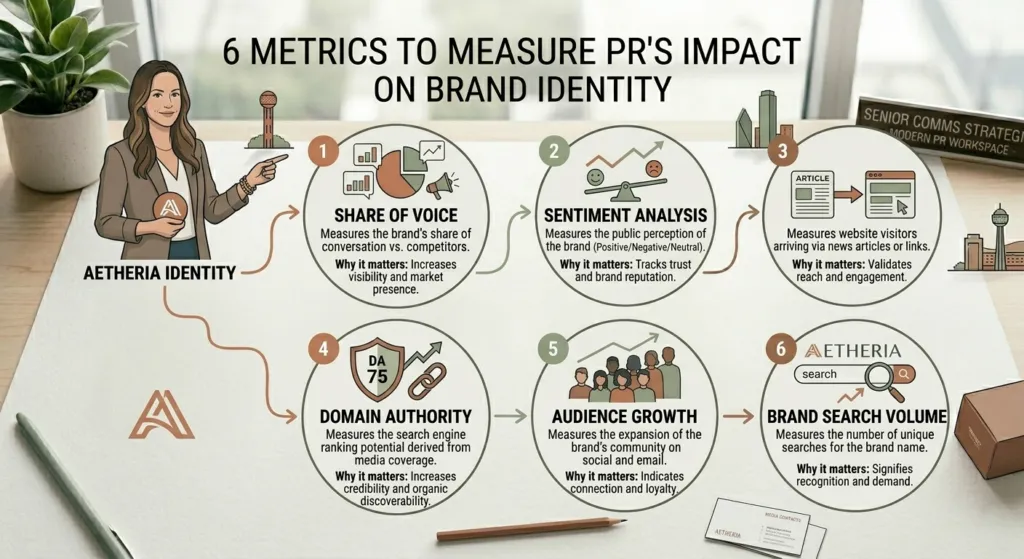
Share of voice. How often is your brand mentioned in relevant conversations relative to competitors? This is a measure of narrative presence – how much of the story in your space belongs to you.
Sentiment analysis. Not just whether your brand is being mentioned, but how. Positive, neutral, or negative – and what specific associations are being built around your brand?
Referral traffic from earned coverage. Digital PR coverage that drives traffic back to your website is directly measurable. Track which placements send the most relevant traffic and adjust your targeting accordingly.
Domain authority growth. Links from digital PR coverage build domain authority over time, improving organic search performance. This is a long-tail metric that reflects the cumulative value of earned media.
Audience growth and engagement. PR coverage that expands your reach shows up in audience growth across your owned channels – social media followers, email subscribers, website visitors.
Brand search volume. When more people are searching for your brand by name, it is a signal that awareness is growing. Track branded search volume over time as an indicator of PR impact.
No single metric tells the full story. The goal is a picture of brand perception that is growing more positive, more consistent, and more aligned with the identity you are intentionally building.
Bringing It All Together – An Integrated Modern PR Approach
The most powerful modern PR strategy is not one tactic executed in isolation. It is an integrated approach where digital media, social channels, podcast appearances, content, and influencer partnerships all work together – aligned around a clear brand identity and a consistent narrative.
Here is what that looks like in practice:
You publish a research-backed blog post on a topic where your brand has genuine expertise. You pitch that article as a contributed piece to two or three relevant digital publications. The coverage generates backlinks and referral traffic. You share the coverage on LinkedIn with your own perspective added. A podcast host who follows you sees the post and invites you to discuss the topic on their show. You appear on the podcast, stay on-message, and drive listeners back to your site. A micro-influencer in your space shares the episode with their audience. New people discover your brand through a trusted voice – and their first impression is a 45-minute conversation with your founder demonstrating genuine expertise.
That is compounding brand identity building. Every tactic amplifies the others. The brand impression that reaches the new audience member is consistent, credible, and multi-layered.
It does not happen by accident. It happens through a clear brand identity, a consistent narrative, and a coordinated PR strategy that uses every available channel strategically.
Final Thoughts
Modern PR is not more complicated than traditional PR. It is more expansive. More direct. More integrated with the brand strategy and the digital channels that shape perception today.
The brands that use it well are not necessarily the ones with the biggest budgets or the most media connections. They are the ones with the clearest brand identity, the most consistent narrative, and the discipline to show up strategically across multiple channels over time.
The opportunity is significant – and it is available to every business, entrepreneur, and public figure willing to invest the intention and effort required.
Build the identity. Shape the narrative. Use every channel available to you. And let the consistency do the work that no single campaign ever could.
If you are ready to build a brand identity that is strong enough to support a powerful modern PR strategy, explore Amnis Beacon’s brand strategy and identity services or get in touch to start a consultation.
Amnis Beacon specializes in brand identity and brand strategy consulting for businesses, public figures, and influencers. We combine analytics, psychology, and market intelligence to build brands that are credible, consistent, and built to grow.