
The businesses that will win in 2026 are not the ones spending the most on advertising.
They are the ones that have figured out how to make PR and marketing work together.
For years, PR and marketing were treated as separate disciplines – different teams, different budgets, different goals. PR focused on earned media and reputation. Marketing focused on paid channels and lead generation. The two operated in parallel, occasionally overlapping but rarely integrating.
That separation is now a competitive disadvantage.
The brands growing fastest in 2026 are the ones that have collapsed the wall between PR and marketing – using credibility to fuel campaigns, using campaigns to amplify coverage, and using brand identity as the through-line that makes all of it work together.
This guide breaks down five essential strategies that combine PR and marketing for business success in 2026 – and how to apply each one regardless of your size, budget, or industry.
Why PR and Marketing Work Better Together
Before getting into the strategies, it is worth understanding why the integration matters.
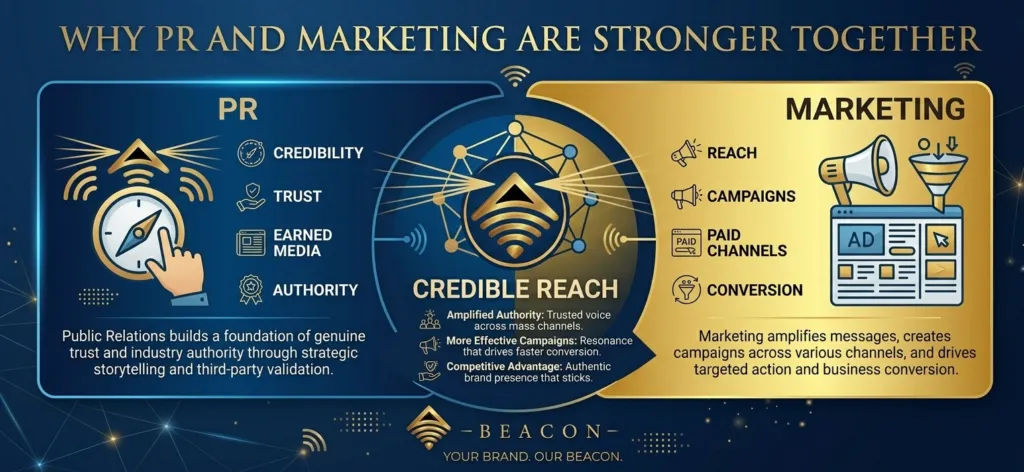
PR builds credibility. It earns trust through third-party validation – media coverage, expert positioning, community recognition, and earned visibility. But credibility without reach has limited impact.
Marketing builds reach. It gets your message in front of audiences at scale – through paid channels, content distribution, email, and social media. But reach without credibility is increasingly expensive and increasingly ignored.
Together, they create something neither can produce alone: credible reach. A brand that is both trusted and visible. A business that earns attention and converts it into growth.
The integration also creates efficiency. PR coverage amplified through marketing channels compounds the value of earned media. Marketing campaigns grounded in genuine credibility convert at higher rates. Content built for PR purposes serves double duty as marketing assets. Every dollar and every effort works harder when the two disciplines are aligned.
In 2026, with rising ad costs, declining organic reach, and audiences that are more skeptical of promotional messaging than ever, that integration is not just smart strategy. It is survival.
Strategy 1 – Lead with Thought Leadership, Follow with Marketing
Thought leadership is the most powerful credibility-building tool available in 2026 – and the brands that use it as the engine for their marketing are outperforming those that lead with promotional content.
The strategy is straightforward. Develop a clear, substantive point of view on a topic where your brand has genuine expertise. Publish that perspective through a combination of owned channels (your blog, LinkedIn, email) and earned channels (contributed articles, podcast appearances, media commentary). Then use marketing to amplify the reach of that credibility-building content to your target audience.
The sequence matters. You are not leading with “buy from us.” You are leading with “here is something genuinely useful, insightful, or important” – and earning the right to market to that audience through the credibility you have already demonstrated.
In practice this looks like: publishing a research-backed article on your blog, pitching it as a contributed piece to a relevant industry publication, earning the placement, sharing it across your social channels with your own perspective added, and then running a targeted paid amplification campaign to get that credible, editorial content in front of more of the exact audience you want to reach.
The result is a paid promotion that does not feel like a paid promotion – because the content at the center of it has already been validated by a third party. Credibility and reach, working together.
For 2026 specifically, the thought leadership topics that cut through the noise are the ones grounded in specific data, direct experience, or a perspective that challenges conventional wisdom. Generic expertise does not earn attention anymore. Specific, substantive, and occasionally contrarian perspectives do.

Strategy 2 – Build an Earned Media Engine
Earned media – coverage in publications, podcasts, industry blogs, and digital outlets your audience trusts – is one of the highest-value marketing assets a brand can have in 2026. And unlike paid media, it compounds.
An earned media engine is a systematic approach to generating consistent coverage rather than pursuing it opportunistically. It treats media relations as an ongoing function of the business rather than a one-time campaign.
Here is what an earned media engine looks like in practice:
A story calendar. Map out the news, milestones, data, and narratives your brand can pitch throughout the year. Product launches, research findings, hiring announcements, partnership deals, seasonal angles, industry trend commentary – anything that gives media a reason to cover you. Plan it in advance rather than scrambling reactively.
A targeted media list. Not a generic list of every journalist who covers your industry. A specific, curated list of the publications, podcasts, newsletters, and outlets your ideal audience trusts – with individual contacts, their beat, and notes on what they have covered recently.
A regular pitching cadence. Treat media outreach the way you treat any other business development activity. Set a weekly or monthly cadence for pitching, follow-up, and relationship building. Consistency creates compounding results.
Marketing amplification for every placement. Every piece of earned coverage gets amplified across your owned and paid marketing channels. Social posts, email newsletter mentions, website press page updates, and targeted paid promotion to extend the reach of every earned placement.
The marketing investment in amplifying earned coverage is one of the highest-ROI activities available. You have already done the hard work of earning the credibility. Amplifying it through marketing ensures that credibility reaches the maximum possible audience.
Strategy 3 – Make Your Brand Identity the Campaign Brief
In 2026, the brands cutting through the noise are not the ones with the cleverest campaigns. They are the ones with the clearest brand identities – and the discipline to build every campaign on that foundation.
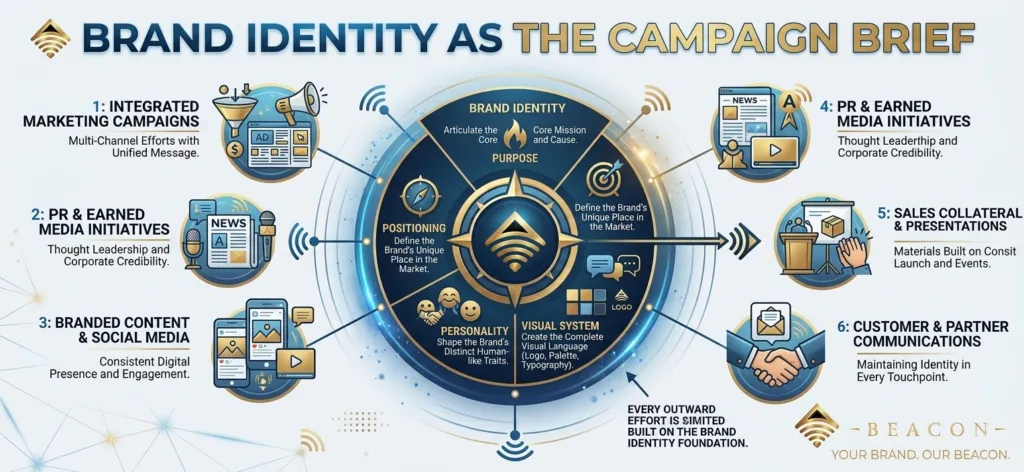
Brand identity is not just a design system. It is the strategic brief that every marketing campaign and every PR initiative should be built from. Your purpose, your positioning, your personality, your voice, your visual system – these are the constants that every variable campaign is built around.
When your brand identity is the campaign brief, several things happen automatically. Your marketing and PR become consistent across channels and over time. Your audience builds a coherent mental picture of who you are. Each campaign compounds the recognition built by the last. And your brand begins to feel familiar – which is one of the most powerful drivers of trust and purchase decisions.
The practical application is simple but requires discipline. Before any campaign is developed, before any PR initiative is launched, before any content is created – return to the brand identity foundation. Does this campaign reflect our positioning? Does this content sound like our brand voice? Does this visual direction align with our identity system? Does this PR angle reinforce the perception we are intentionally building?
Those questions, asked consistently, are the difference between a brand that builds recognition over time and one that constantly resets.
For businesses in 2026, this discipline is especially important as the number of channels and content formats continues to expand. More channels mean more opportunities for inconsistency. A brand identity that functions as a genuine strategic brief is what prevents that expansion from becoming dilution.
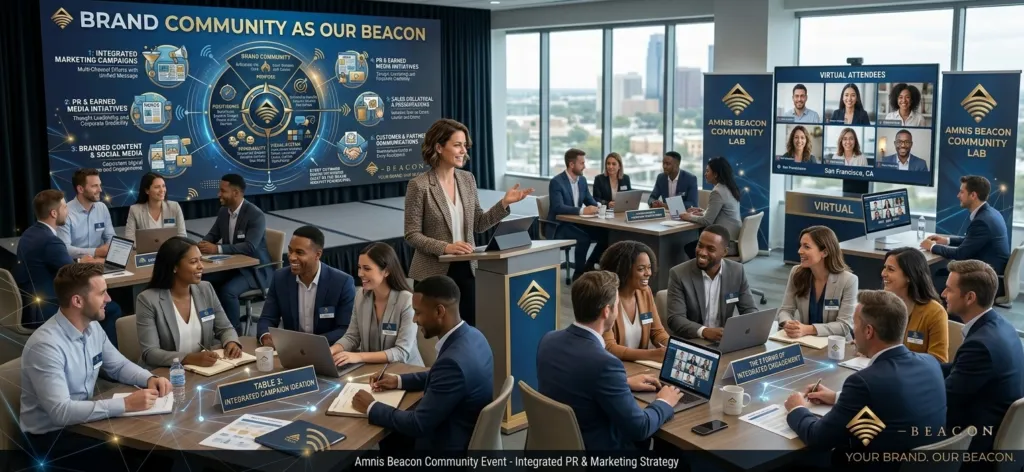
Strategy 4 – Use Community as Both PR and Marketing
Community building has emerged as one of the most powerful and most underutilized strategies available to brands in 2026. And it is uniquely positioned at the intersection of PR and marketing.
On the PR side, a genuine brand community generates word-of-mouth advocacy, earned media, and social proof that no campaign can manufacture. Community members become spokespeople. Their testimonials, reviews, and recommendations reach audiences your own channels cannot. Their loyalty is visible – and visibility of loyalty is one of the most persuasive signals a potential customer can encounter.
On the marketing side, a community is a direct, owned channel with an audience that has already opted in to a relationship with your brand. The conversion rates, engagement levels, and lifetime value of community members consistently outperform cold audience marketing – because the trust is already established.
Building a brand community in 2026 starts with identifying the shared interest, identity, or aspiration that connects your ideal customers to each other – not just to your brand. The strongest communities are not built around a product. They are built around a perspective, a goal, a challenge, or a way of seeing the world that your brand understands and gives language to.
Practically, community building shows up in different forms depending on your brand and audience. A private online group for clients and prospects. A consistent LinkedIn newsletter that attracts a specific professional audience. A regular event – virtual or in-person – that brings your audience together around a topic you own. A branded hashtag or movement that gives your community a shared identity.
The investment required is real – community building takes time, consistency, and genuine participation from the brand. But the return is a marketing and PR asset that compounds in value the longer it grows, and that competitors cannot easily replicate.
Strategy 5 – Integrate Data and Storytelling
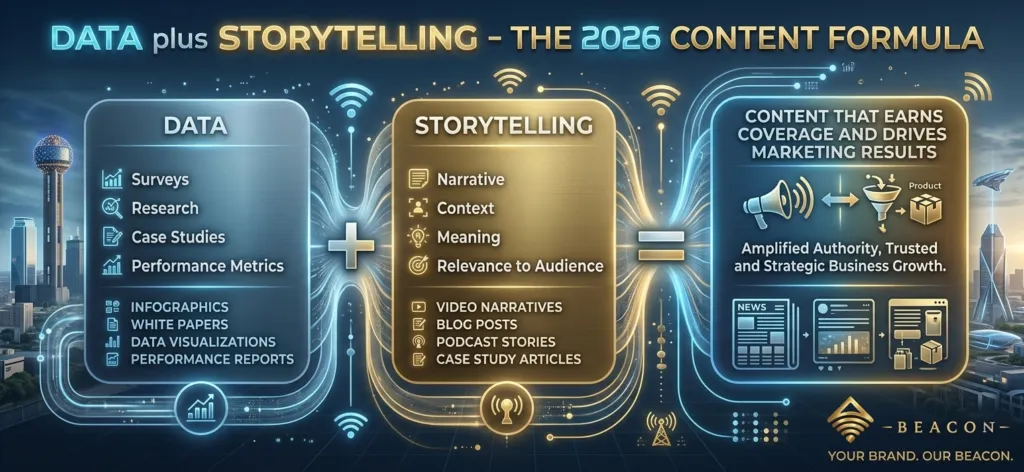
In 2026, the brands generating the most earned media and the highest-performing marketing content are the ones combining two things that most brands keep separate: data and storytelling.
Data alone is not compelling. A spreadsheet of findings does not earn coverage or drive engagement. But data wrapped in a compelling narrative – a story about what the numbers mean, why they matter, and what they reveal about something your audience cares about – is one of the most powerful content assets a brand can produce.
Proprietary data is particularly valuable. When your brand can say “we surveyed 500 customers and here is what we found” or “we analyzed 12 months of client results and here is the pattern” – that is original, citable, shareable content that earns media attention, builds authority, and functions as a marketing asset simultaneously.
The PR application: data-driven content is among the most pitchable material available. Journalists and editors are constantly looking for data to support their stories. When your brand is the source of that data, you become a credible reference point – cited, linked to, and quoted. That coverage builds both brand awareness and domain authority.
The marketing application: data-driven content performs consistently well across almost every marketing channel. It is more credible than opinion-based content. It is more shareable because it gives people something specific to reference. It is more persuasive because it demonstrates expertise through evidence rather than assertion.
For businesses that do not have large proprietary datasets, there are accessible alternatives. Aggregate and analyze publicly available data through your brand’s specific lens. Survey your own clients or audience – even a small sample produces useful insights. Document patterns from your own work and present them as findings. The standard is not academic rigor – it is genuine insight presented with integrity.
The integration of data and storytelling also applies to your marketing performance itself. The brands that are winning in 2026 are the ones that can tell a clear story about the results they produce – for their clients, for their communities, and for their own growth. That narrative of proven results is both a PR asset and a marketing differentiator.
Putting It All Together – An Integrated 2026 PR and Marketing Calendar
The five strategies above are most powerful when they are coordinated – running in parallel and reinforcing each other across the full year.
Here is what a simple integrated PR and marketing calendar looks like in practice:
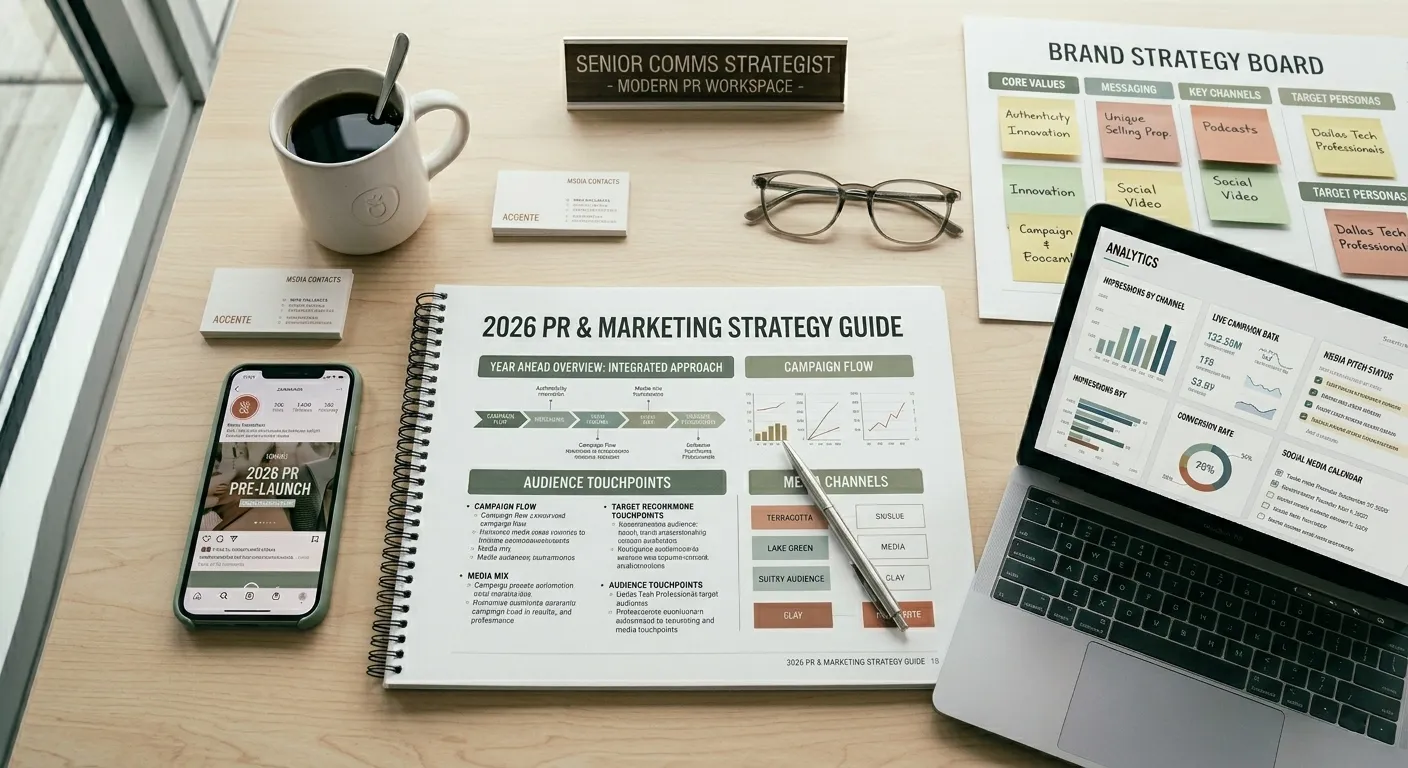
Q1 – Establish authority. Publish your brand’s primary thought leadership content for the year. A research report, a definitive guide, or a strong perspective piece that establishes your brand’s point of view. Pitch it to media. Amplify it through marketing. Use it to anchor your messaging for the months ahead.
Q2 – Build community and earned media. Launch or reinvigorate your community-building effort. Increase your pitching cadence. Focus on podcast appearances and contributed articles. Amplify every placement through owned and paid marketing channels.
Q3 – Deepen relationships and generate data. Run a client or audience survey to generate proprietary data for Q4 content. Deepen media relationships built in Q1 and Q2. Focus on case studies and results stories that demonstrate the value your brand delivers.
Q4 – Publish data-driven content and plan for the year ahead. Release your survey findings or research report. Pitch the data to relevant media. Use the results in marketing campaigns. Close the year with content that positions your brand as the authoritative voice in your space heading into the new year.
This is not a rigid formula. It is a rhythm – one that creates a consistent flow of credible, brand-aligned content and coverage that compounds in value over the full year.
Final Thoughts
The brands that will lead in 2026 are not waiting for the perfect campaign or the perfect moment. They are building – consistently, strategically, and with clarity about who they are and who they serve.
PR and marketing working together – grounded in a strong brand identity and executed with consistency – is not a growth hack. It is a growth system. One that gets more efficient and more effective the longer it runs.
Thought leadership that earns credibility. Earned media that gets amplified through marketing. Brand identity that functions as the brief for every initiative. Community that creates marketing and PR simultaneously. Data and storytelling that earns coverage and drives conversion.
These are not trends. They are fundamentals – and in 2026, they are the competitive advantage that separates the brands that are growing from the ones that are grinding.
If you are ready to build the brand identity and strategic foundation that makes every PR and marketing effort work harder, explore Amnis Beacon’s brand strategy services or get in touch to start a consultation.
Amnis Beacon specializes in brand identity and brand strategy consulting for businesses, public figures, and influencers. We combine analytics, psychology, and market intelligence to build brands that are credible, consistent, and built to grow.