


Trust is the most valuable thing a brand can earn.
Not attention. Not impressions. Not followers. Trust.
Trust is what converts a first-time visitor into a paying customer. It is what turns a satisfied customer into a loyal advocate. It is what allows a brand to raise prices, enter new markets, and weather public challenges without losing the audience it has built.
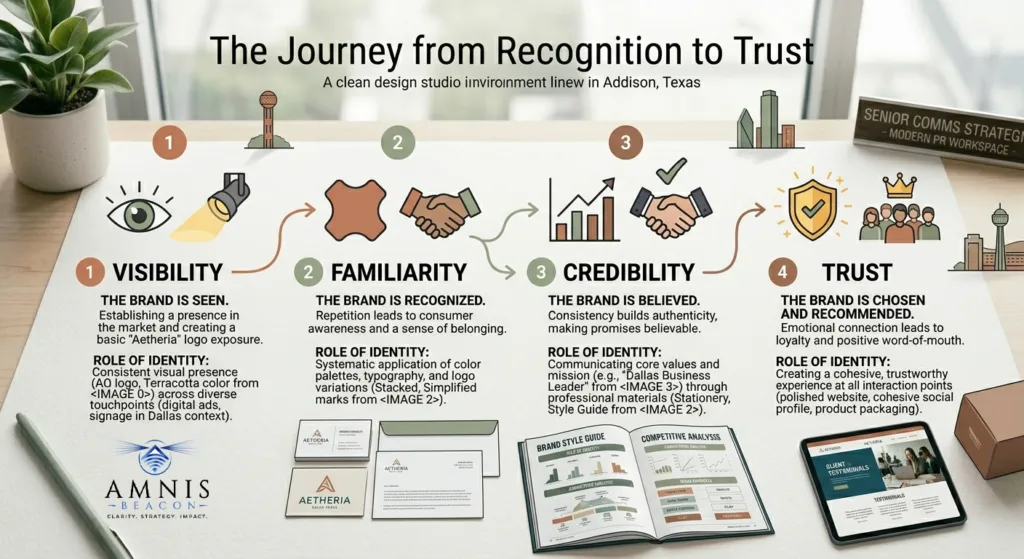
And trust does not arrive fully formed. It is built – gradually, systematically, through a process that starts with something far more accessible: recognition.
This is the journey at the heart of every strong brand identity. From visibility to familiarity. From familiarity to credibility. From credibility to trust. And from trust to the kind of loyalty that becomes a genuine business asset.
Understanding how that journey works – and how brand identity is the vehicle that drives it – is one of the most important things any business owner, entrepreneur, or public figure can do for their brand.
Recognition and Trust Are Not the Same Thing
It is worth being precise about this from the start, because the two are often conflated.
Recognition is awareness. It is the moment your audience sees your logo, hears your name, or encounters your visual identity and knows who you are. Recognition is a cognitive event. It means the brand has moved from unknown to familiar in the mind of your audience.
Trust is something deeper. Trust is the belief that your brand will consistently deliver on what it promises – that it is credible, reliable, and aligned with the values and expectations of the people it serves. Trust is an emotional and experiential state. It is earned over time through repeated positive encounters with a brand that shows up the same way, every time.
The relationship between the two is sequential. You cannot build trust without first building recognition. But recognition alone does not produce trust. There are brands that are highly recognizable and deeply distrusted. Recognition is the beginning of the journey, not the destination.
Brand identity is what moves a brand from one to the other.
How Brand Identity Creates Recognition
Recognition is built through repetition and consistency. Every time your audience encounters your brand and it looks, sounds, and feels the same as the last time, a connection is reinforced in their memory. Over time, those reinforced connections become automatic – the color, the shape, the voice, the feeling – recognition without conscious effort.
This is not an accident of good design. It is the deliberate function of a well-built brand identity system.
Your logo creates a visual anchor – a specific shape and mark that the brain learns to associate with your brand. Your color palette triggers recognition before the logo is even read – color is processed faster than language, and consistent color use builds one of the fastest recognition pathways available. Your typography creates a visual rhythm that reinforces the brand impression even when the specific elements are absent. Your imagery style creates a visual world that feels unmistakably like your brand. And your brand voice creates recognition through language alone – a distinct way of communicating that your audience can identify before they see a single visual element.
When all of these elements are applied consistently – across your website, your social media, your marketing materials, your communications, your physical presence – the exposure compounds. Each encounter adds to the accumulated impression. The brand moves from unknown to occasionally noticed to reliably familiar.
That familiarity is the foundation on which trust is built.
The Psychology Behind the Trust Journey
Understanding why recognition leads to trust – not just that it does – gives you a strategic advantage in how you build and manage your brand identity.
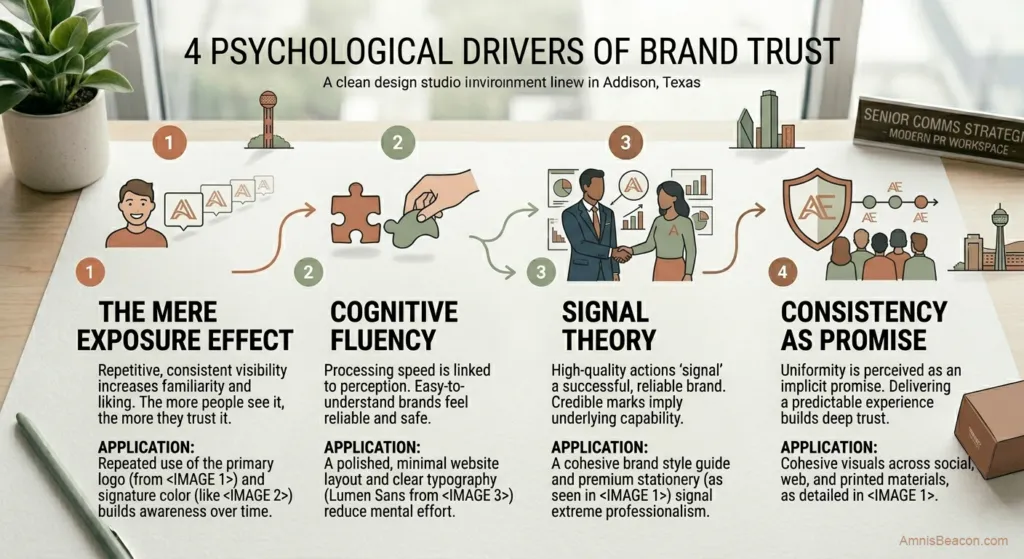
The mere exposure effect. One of the most well-documented findings in psychology is that people develop a preference for things they have been exposed to repeatedly. Familiarity, all else being equal, feels safe. The brain interprets repeated exposure as a signal of reliability – this thing has been present before, and nothing bad happened. In the context of brand identity, consistent exposure builds a subconscious preference before the audience has made any conscious evaluation of your brand.
Cognitive fluency. When something is easy for the brain to process, it feels more credible. A brand identity that is clear, consistent, and visually coherent is easier to process than one that is cluttered, inconsistent, or confusing. That ease of processing translates into a feeling of familiarity and reliability – which contributes directly to perceived trustworthiness.
Signal theory. Audiences use visible signals to make inferences about invisible qualities. A polished, professional brand identity signals investment, seriousness, and attention to detail – qualities that are hard to verify directly but easy to infer from the care taken with the brand. The logic is intuitive: a brand that cares enough to present itself this carefully is likely a brand that cares about its customers and its product.
Consistency as a promise. Every time your brand shows up the same way, it is implicitly making and keeping a promise. The promise is not stated – it is demonstrated. And demonstrated reliability, repeated over time, is one of the most powerful builders of trust available.
These are not abstract psychological concepts. They are the mechanisms operating beneath every strong brand identity – and understanding them makes it easier to make deliberate decisions about how to build and manage yours.
Where Brand Identities Lose Trust
Knowing how recognition becomes trust is only half the picture. The other half is understanding how trust is lost – often quietly, and often through the very inconsistencies that most brands do not notice until the damage is done.
Visual inconsistency. When your brand looks different across channels – a different color on Instagram, a different logo version on your website, a different style of imagery in your email campaigns – your audience cannot build a reliable mental picture of who you are. Every inconsistency resets a small piece of the recognition that has been built. Over time, the accumulation of those resets produces a brand that feels unsettled, unprofessional, or unserious – regardless of the actual quality of the product or service.
Verbal inconsistency. When your brand voice shifts dramatically from one context to another – formal and corporate in one place, casual and unrelated in another – your audience senses the inconsistency even if they cannot name it. It creates a feeling that the brand is performing rather than authentic. And perceived inauthenticity is one of the fastest ways to erode trust.
Gaps between promise and delivery. Brand identity creates expectations. When the polished, professional identity promises a premium experience and the actual customer experience does not deliver on that promise, the gap damages trust more severely than a weaker identity would have. The stronger the brand signal, the higher the expectation – and the more damaging the gap when it is not met.
Reactive rebranding. Changing your brand identity frequently – in response to trends, internal preferences, or competitive pressure – resets the recognition you have built and signals instability. Audiences interpret frequent brand changes as a sign that the brand does not know who it is. And a brand that does not know who it is cannot be trusted to consistently deliver.
Absence. Brands that disappear from their audience’s awareness – going quiet on their channels, inconsistently showing up, or failing to maintain a consistent presence – lose the familiarity that recognition requires. Trust requires consistency over time. Absence breaks that continuity.
What Consistent Brand Identity Does for Business Performance
The connection between brand identity, recognition, and trust is not just philosophical. It has direct, measurable impact on business performance.
Higher conversion rates. Audiences that recognize and trust a brand convert at significantly higher rates than those encountering it for the first time. The trust built through brand identity does pre-sale work that no individual campaign can replicate – by the time a known, trusted brand makes an offer, the hardest part of the sale is already done.
Stronger pricing power. A strong brand identity signals value before the product or service is evaluated. Audiences associate the quality of the brand presentation with the quality of the offering itself. Brands with strong, consistent identities can charge more – not because their product is necessarily superior, but because the perception of value is higher.
Lower customer acquisition costs. Recognition reduces friction. When a potential customer already knows who you are and has a positive association with your brand, the cost and effort required to convert them is substantially lower than the cost of converting someone encountering your brand for the first time.
Higher customer retention. Trust drives loyalty. Customers who trust a brand stay longer, spend more, and are far less susceptible to competitive offers. The investment in building trust through consistent brand identity pays compounding returns through the lifetime value of retained customers.
Organic referrals. Trusted brands generate word-of-mouth at significantly higher rates than unfamiliar ones. When customers trust a brand, they recommend it – not because they have been asked to, but because recommending something they trust feels like an extension of their own credibility.

Building a Brand Identity That Earns Trust – A Practical Framework
Understanding the theory is one thing. Applying it is another. Here is a practical framework for building the kind of brand identity that earns recognition and converts it into trust.
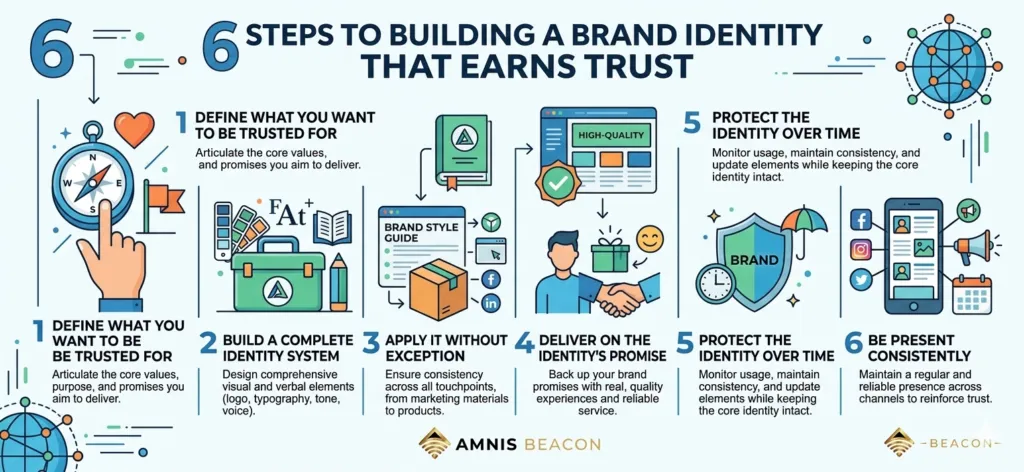
Define what you want to be trusted for. Trust is specific. You are not building trust in general – you are building trust in something particular. Your expertise, your reliability, your values, your quality, your point of view. Be specific about what you want your brand to be trusted for, and make sure every element of your identity communicates that quality consistently.
Build a complete identity system. Recognition requires consistency, and consistency requires a complete system. Logo, color palette, typography, imagery style, brand voice, messaging, and guidelines. Every element working together, every touchpoint covered. Partial identity systems produce partial recognition.
Apply it without exception. The system only works if it is applied everywhere, all the time. Not just on the website. Not just in the marketing materials. Every email, every social post, every proposal, every conversation, every physical presence. Consistency without exception is what builds the kind of deep familiarity that trust requires.
Deliver on the identity’s promise. Brand identity creates expectations. The customer experience must meet or exceed those expectations – every time. The brand that promises premium and delivers average does more damage to trust than a brand that never promised much at all. Align your identity with the reality of your offering, and then consistently deliver on both.
Protect the identity over time. Trust is built slowly and lost quickly. Protect your brand identity from drift – inconsistent application, reactive changes, and trend-chasing that pulls the brand away from the clear, consistent impression it has built. Evolve intentionally and strategically. Change what genuinely needs to change and protect what is working.
Be present consistently. Recognition requires regular exposure. Show up for your audience consistently – through your content, your communications, your social presence, your community engagement. Absence creates familiarity gaps. Consistent presence builds the cumulative exposure that recognition and trust require.
The Long Game
Trust is a long game. It is built through hundreds of consistent encounters, kept promises, and reliable experiences – accumulated over time into a brand reputation that becomes one of the most valuable assets a business can own.
The brands that understand this do not chase shortcuts. They do not rebrand every two years because the aesthetic feels stale. They do not sacrifice consistency for the sake of a trend. They do not make promises their product cannot keep.
They build a clear identity. They apply it everywhere. They show up consistently. They deliver on what they promise. And they do all of it, over and over, until the recognition is so strong and the trust so deep that their brand becomes the default choice for the people they serve.
That is the journey from recognition to trust. It is not complicated. But it requires the clarity, the discipline, and the long-term commitment that most businesses are not willing to make – which is exactly why the ones that do make it become the brands that are impossible to forget and very difficult to compete with.
If you are ready to build a brand identity designed to earn recognition and convert it into lasting trust, explore Amnis Beacon’s brand identity services or get started with the Brand Starter Kit.
Amnis Beacon specializes in brand identity and brand strategy consulting for businesses, public figures, and influencers. We combine analytics, psychology, and market intelligence to build brands that are credible, consistent, and built to grow.