
The Silent Handoff Problem: How Internal Branding Breaks Down One Unacknowledged Transfer at a Time
What Is a Silent Handoff?
A silent handoff happens when work, responsibility, or a piece of a conversation moves from one person or system to another without anyone explicitly confirming that the transfer happened. No one drops the ball on purpose. The ball just rolls from one set of hands to another, and nobody says “got it.”
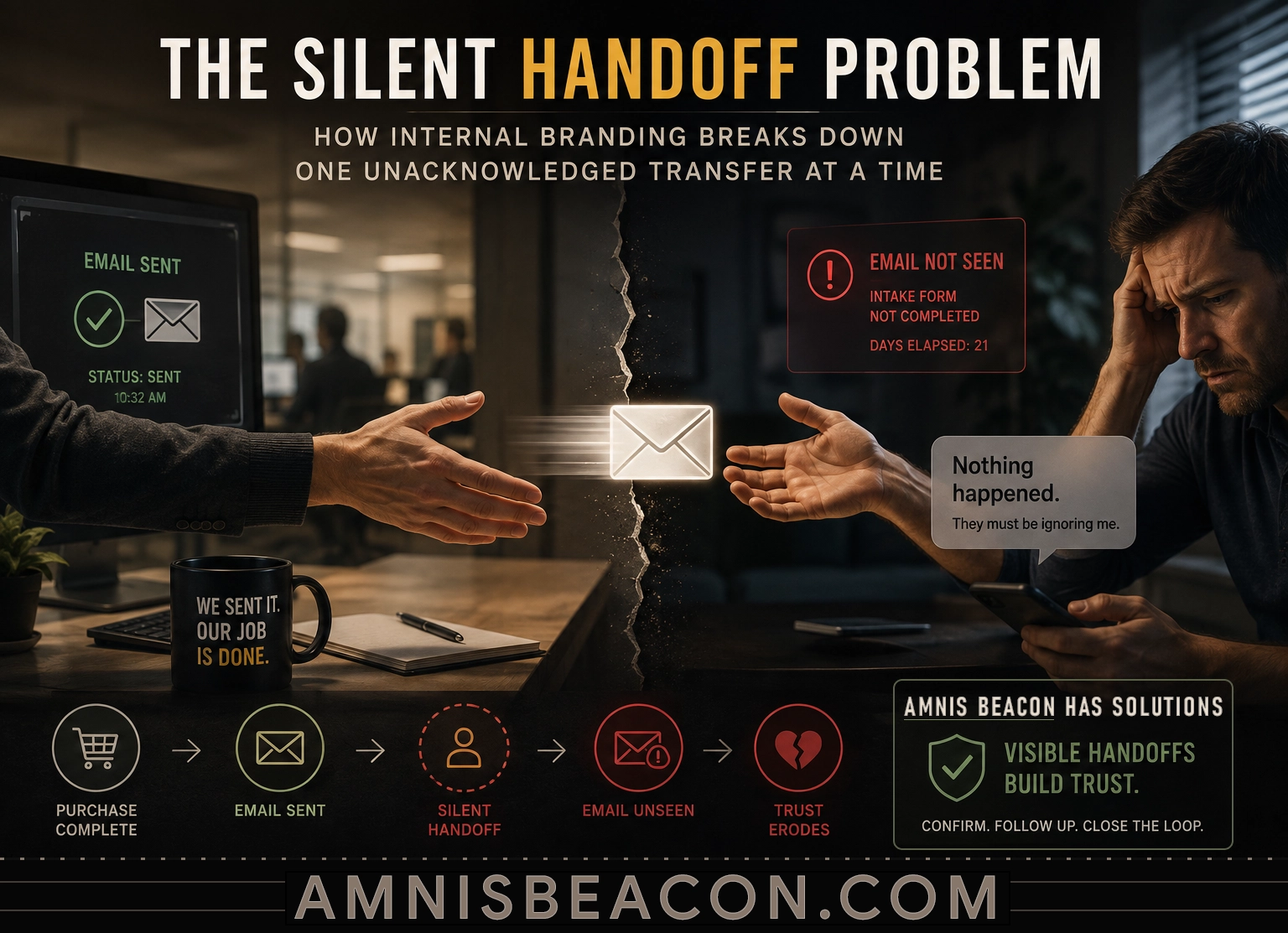
In customer facing businesses, silent handoffs usually look like this: a client completes a purchase, an automated email goes out with next steps, and the business considers its job done. Meanwhile the client never sees that email (it lands in spam, or goes to an account they rarely check), and from where they’re sitting, nothing happened at all. The handoff, from “purchase complete” to “here’s what you do next,” occurred entirely on the business’s side of the wall. The client was never actually looped in.
This is where silent handoffs stop being a project management footnote and start becoming a branding problem.
Why Internal Branding Depends on Visible Handoffs
Internal branding is usually described as the culture, values, and standards a company holds for its own team, the internal version of what customers see externally. But internal branding also shows up in something less obvious: how information moves between the people and systems inside a company before it ever reaches the customer.
Every one of those internal transfers, a lead moving from sales to onboarding, an intake form moving from “sent” to “completed,” a support ticket moving from one team member to another, is an opportunity for a silent handoff. And every silent handoff is a moment where the brand experience quietly diverges from what the company intended it to be.
The customer doesn’t experience your internal org chart. They experience the sum of every handoff that happened (or didn’t happen) behind the scenes. When those handoffs are silent, the brand starts to feel inconsistent, unreliable, or even personal in a way that was never intended.

A Real Example: When a Missed Email Becomes a Trust Problem
Consider a small business that recently worked through a negative review left with the Better Business Bureau. The situation, once unpacked, wasn’t really about bad service or bad faith. It came down to a chain of quiet, unacknowledged handoffs:
- A client made a purchase and was automatically sent an intake form by email, a required step before the business could begin work.
- That email went to an address the client didn’t check regularly, or it landed in spam.
- The internal team assumed the handoff was complete because the email had been sent. No one confirmed it had been received or opened.
- Weeks passed. The client felt ignored. The business felt like it had done its part.
By the time the two sides talked it through, both were right, and both had been let down by the same silent handoff. The email was sent (the business’s system did its job). The email was never seen (the client’s side of the loop never closed). Nobody in the middle was tracking whether the handoff had actually landed.
The business owner, working through the aftermath, put it plainly: sometimes technology breaks, and if you don’t know it’s broken, you don’t know to go look for it. That’s the essence of a silent handoff. It’s not usually a failure of effort. It’s a failure of confirmation.
The Emotional Cost Nobody Budgets For
What makes silent handoffs especially damaging to a brand is what happens after the process breaks down. In the case above, the client didn’t just feel like a form got lost. He felt personally deprioritized, wondering if the business only paid attention to bigger accounts. The business owner, for his part, felt blindsided that a communication gap had been read as a judgment about the client’s value.
Neither read was really about the person. Both were downstream effects of a handoff that happened without anyone confirming it. When information disappears silently between two parties, the parties don’t conclude “the system failed.” They conclude something about each other, usually the least generous interpretation available.
That’s the real cost of a silent handoff. It’s not just a delayed task. It’s a story the other person tells themselves to fill in the gap you left open.
Fixing Silent Handoffs Inside Your Brand
A few practical shifts can close most silent handoff gaps before they turn into trust problems:
Treat every handoff as a tracked task, not an assumption. If an email, form, or file needs to move from one party to another, someone should own confirming it arrived, not just confirming it was sent.
Name the receiver, not just the sender. “We sent it” isn’t the same as “they got it.” Internal processes should require acknowledgment from whoever is supposed to act next, whether that’s a team member or the client themselves.
Build a check-in step for anything automated. Automated emails and system-generated next steps are efficient, but they’re also where silent handoffs multiply. A short manual follow-up, even a phone call, catches the gaps automation quietly creates.
When a handoff breaks, talk about it openly. The fastest way to defuse the emotional weight of a missed handoff is a direct conversation. In the example above, one real conversation was enough to turn a public complaint into an ongoing relationship, not because the mistake was erased, but because it was acknowledged out loud.
The Bigger Picture
Silent handoffs aren’t a technology problem or a customer service problem on their own. They’re an internal branding problem, because internal branding is really just the sum of how consistently your team confirms, communicates, and closes the loop with each other and with the people you serve.
A brand that closes its loops out loud, that treats “did they actually get this” as seriously as “did we send this”, builds trust even when things go wrong. A brand that lets handoffs happen silently will eventually have those gaps show up in a review, a lost client, or a story that was never quite true, but felt true because no one said otherwise.
Closing the Loop: A Fix Amnis Beacon Builds
Knowing where the gap is doesn’t automatically close it. Most businesses already suspect that some of their emails go unread, they just don’t have a way to know which ones, or when to actually do something about it.
That’s the kind of problem we solve at Amnis Beacon.
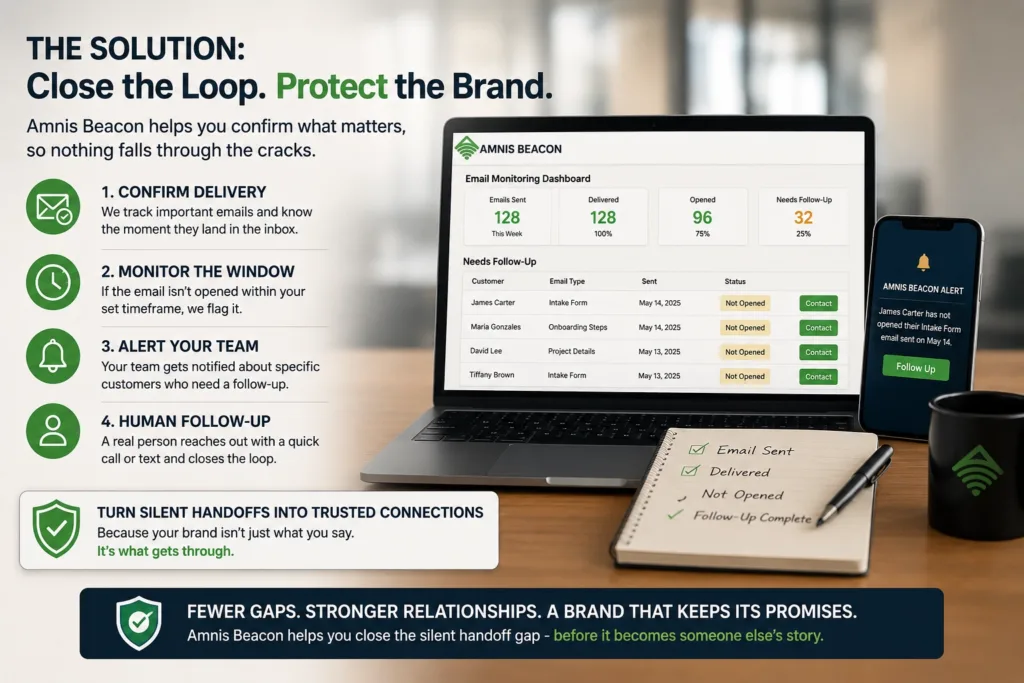
Here’s the fix, in plain terms: we build a simple tool that keeps watch over the important emails a business sends to its customers (an intake form, a confirmation, a next step in onboarding). Depending on how the business already operates, that might take shape as a small custom WordPress plugin, or as a lightweight piece of code running directly on the business’s own server, whatever fits the setup that’s already in place. Either way, it knows the moment an email actually lands in the customer’s inbox. Then it waits.
If the customer opens that email within a set timeframe, nothing else needs to happen. The loop closed itself.
But if that window passes and the email still hasn’t been opened, the tool doesn’t just let it sit there unnoticed. It automatically alerts one of the business’s team members, letting them know a specific customer hasn’t seen an important message yet. That employee can then step in with a quick call or text, the kind of human follow up that catches a problem before it ever turns into a frustrated client, a stalled project, or a public complaint.
In other words, this turns “we sent it, so our job is done” into “we sent it, we confirmed it landed, and if it wasn’t seen in time, a real person followed up.” That one shift closes the exact gap that so often turns a simple technical hiccup into a trust problem.
Silent handoffs like this are happening inside most businesses right now, without anyone even knowing. Amnis Beacon builds the kind of follow up systems that close those loops before customers have to point them out.